The Future of Artificial Intelligence: From 2024 Reality to 2035 and Beyond
Key Takeaways
AI has moved from lab demos (2017 transformers, 2022 ChatGPT) to a 2024–2026 deployment wave across business, government, and everyday life, with global private investment surpassing $100 billion annually.
By 2030–2035, AI is projected to add trillions of dollars to global GDP through smaller multimodal and agentic systems embedded in phones, vehicles, factories, and homes.
The artificial intelligence future presents a fundamental trade-off: massive productivity and scientific progress balanced against real risks around job displacement, misinformation, safety, and climate impact.
Regulation-including the EU AI Act (2024–2026 rollout), U.S. executive orders, and China’s model rules-plus better ai governance will determine whether AI remains a net positive.
For those who want to stay informed without drowning in daily hype, KeepSanity AI offers a weekly, noise-free summary covering only the major developments that actually matter.
Introduction: Why the Future of AI Matters in 2026
Take a snapshot of 2026: GPT-4.1/4.5-class ai models are routine office tools, GPT-4o-mini-style systems are embedded in apps and devices, and companies are rolling out AI copilots to millions of human workers. This isn’t science fiction-it’s the current reality.
This article is for professionals, students, and anyone interested in understanding how artificial intelligence will shape the next decade. Understanding the future of AI is crucial for making informed decisions about careers, investments, and policy in a rapidly changing world.
How did we get here? The journey spans 70+ years, from Alan Turing’s 1950 paper on machine intelligence through symbolic AI research, the 2017 transformer breakthrough with “Attention Is All You Need,” to ChatGPT’s November 2022 release that triggered mass adoption. The numbers tell the story: global private AI investment now surpasses $100 billion annually, and more than 70% of organizations report some ai use by 2024–2025.
This article maps the evolution of artificial intelligence, the near-term technology trends shaping 2030–2035, how ai will transform industries, the risks we must navigate, and what all this means for individuals and teams trying to stay informed. Written from KeepSanity AI’s perspective, we’re focused on signal-not daily noise or sponsor-driven hype.
What is Artificial Intelligence? (Glossary & Definitions)
Artificial intelligence (AI) refers to computer systems capable of performing tasks that typically require human intelligence, such as learning, reasoning, and problem-solving. In the future, AI is expected to evolve into autonomous agents and personalized assistants, with breakthroughs like Artificial General Intelligence (AGI) expected by 2027. By 2040, AI will be deeply integrated, ubiquitous, and transformative, with key impacts including personalized AI companions, advanced health monitoring, and agent-based automation.
Multimodal AI: AI systems that can process and understand multiple types of data at once-such as text, images, audio, and video-enabling more natural and flexible interactions.
Agentic AI: AI that can act as an autonomous agent, setting sub-goals, making decisions, and executing multi-step tasks with minimal human intervention.
Artificial General Intelligence (AGI): A form of AI that matches or exceeds human intelligence across a wide range of tasks, not limited to specific domains.

From Theory to Generative AI: A Brief History Shaping the Future
The future of ai rests on foundations built over seven decades. Each milestone created the conditions for what followed, and understanding this trajectory helps us see where things are heading.
Key milestones in AI’s evolution:
1950: Alan Turing publishes “Computing Machinery and Intelligence,” posing the imitation game question and marking the conceptual birth of artificial intelligence.
1956: The Dartmouth workshop coins “artificial intelligence” as a field, launching symbolic AI research.
1957: Frank Rosenblatt introduces the Perceptron, an early neural networks architecture that would inspire decades of deep learning research.
1997: IBM’s Deep Blue defeats Garry Kasparov, showcasing narrow ai’s ability to master specific domains like chess.
2011: IBM Watson wins Jeopardy!, demonstrating natural language processing and question-answering capabilities at scale.
2017: The “Attention Is All You Need” paper introduces transformers, revolutionizing architectures by enabling parallel processing and context awareness.
2020: GPT-3 arrives with 175 billion parameters, shifting ai development toward generative tasks.
2022: ChatGPT’s November release triggers explosive adoption, bringing generative ai to mainstream awareness.
2023-2024: GPT-4 scales to multimodal capabilities, Llama 3 democratizes open-weight models, and generative ai models become standard tools.
Notable 2023–2025 events signal a maturing field: the first global AI Safety Summit at Bletchley Park (November 2023), early versions of the EU AI Act, and big tech companies deploying AI copilots into Office suites, design tools, and coding environments like GitHub Copilot.
These foundations directly influence where ai continues heading: multimodal understanding, autonomous ai agents, and more specialized intelligent systems tailored to specific domains.
The Near Future of AI (2025–2035): Key Technology Trends
The most important AI changes in the next decade aren’t just “bigger models.” The real transformation comes from cheaper, multimodal, agentic, and embedded ai systems that permeate products and infrastructure-from your phone to factory floors.
Think of this section as a roadmap. Each trend below represents a concrete shift that will reshape how ai technology integrates with everyday life and work. Where possible, we’ve anchored predictions to specific timelines and examples to keep the future grounded.
Multimodal AI Becomes the Default Interface
“Multimodal” means one system handling text, images, audio, video, and structured data simultaneously. GPT-4o and Gemini (2023–2025) represent early examples of this capability, but they’re just the beginning.
By roughly 2030, consumer assistants on phones, AR glasses, and cars will routinely accept voice, camera input, and context from other apps-returning mixed responses including text, diagrams, and short videos. This represents a fundamental shift in how ai interacts with human beings.
Expected business use cases include:
Multimodal copilots that read contracts, slide decks, dashboards, and emails together to brief executives
Clinical ai tools that simultaneously review patient scans, lab results, and histories
Design assistants that understand verbal descriptions while analyzing reference images
This enables more natural human-computer interaction. Instead of typing commands, you talk to your devices and show them your environment. For global accessibility, this matters enormously-someone who struggles with keyboards can simply speak and point.
Democratized Model Creation and No-Code AI
By the late 2020s, most organizations will build custom models or ai agents without needing ML PhDs. Hosted platforms, no-code ai tools, and natural-language interfaces will handle the complexity.
Examples from 2024–2026 already point this direction: no-code LLM platforms, AutoML systems, and API-first services that let teams plug in functions like summarization, forecasting, or classification with minimal technical expertise.
Project to around 2030: non-technical staff in marketing, operations, and research can spin up “micro-models” fine-tuned on departmental data in days instead of months.
Picture a small logistics firm training a route-optimization assistant via drag-and-drop workflows, using their own delivery data to improve efficiency without hiring a data science team.
This democratization cuts both ways. It accelerates innovation but also increases the need for guardrails, central ai governance, and clear data policies to avoid “shadow AI”-unapproved deployments risking data leaks and compliance violations.
Agentic AI: From Chatbots to Autonomous Colleagues
Agentic ai represents a fundamental shift from current chatbots. These are ai systems that set sub-goals, call tools or APIs, and execute multi-step workflows semi-autonomously-not just answering single prompts but actually completing complex tasks.
Plausible 2026–2030 scenarios include:
AI agents handling end-to-end employee onboarding: generating paperwork, scheduling training, setting up accounts
Marketing agents running weekly experiments: adjusting campaigns, analyzing results, recommending changes
Operations agents managing datacenter maintenance: scheduling upgrades, ordering parts, coordinating technicians
These agents will coordinate with specialized sub-agents for legal, finance, and operations, escalating to human oversight when confidence is low or policies are triggered. The ai’s ability to chain multiple actions creates efficiency gains impossible with simple query-response systems.
The productivity potential is enormous-but so are the questions about accountability, auditing, and security when agents can act on sensitive computer systems without constant human intervention.
Hardware, Quantum, and New Computing Paradigms
Current ai advancements push against compute, memory, and power consumption limits. This drives massive investment into specialized chips (GPUs, TPUs, custom ASICs) and experimental architectures.
“Beyond the binary” ideas are gaining traction: ternary/bitnet models and neuromorphic chips that mimic brain architecture aim to cut power use while increasing throughput by the late 2020s. Optical computing offers another path to faster processing with lower energy demands.
Quantum computing represents a longer-horizon trend. By early-to-mid 2030s, practical quantum-enhanced algorithms may accelerate optimization, simulation, and some model-training tasks-particularly valuable for:
Logistics and supply chain optimization
Drug design and molecular simulation
Climate modeling
Financial portfolio optimization
For most users, the visible impact will be cheaper, faster, more localized AI. On-device assistants, smart autonomous vehicles, and robotics will run sophisticated ai applications without constant cloud connectivity-not direct interaction with quantum machines.
Data, Synthetic Data, and “Running Out of the Real Web”
By the mid-2020s, high-quality human-generated internet text and images became a bottleneck for training data. Labs are now pivoting toward synthetic data, curated corpora, and domain-specific datasets.
From 2026–2030, synthetic data generation-simulations, procedurally generated environments, self-play-becomes standard for training and testing models in safety-critical domains like robotics and self driving cars.
The trade-offs are significant:
Benefit | Risk |
|---|---|
Reduced privacy concerns | May reinforce model human biases |
Better coverage of rare scenarios | Can drift from real-world distributions |
Scalable generation | Requires careful grounding in reality |
Regulatory pressure and corporate governance will increase logging of data lineage-where training data came from, under which licenses. This favors proprietary, high-quality domain datasets over scraping public data from the whole web. |
Efficiency, Cost, and the Shift to Smaller Models
The numbers are striking: inference costs for GPT-3.5-level ai performance dropped by well over 100x between 2022 and 2024, thanks to hardware and software optimizations.
The future isn’t only giant frontier models. “Small” and “medium” specialized models-GPT-4o-mini-class, edge-optimized LLMs-will deploy in devices, cars, factories, and local servers where cloud connectivity isn’t reliable or desired.
By 2030, everyday products will likely run onboard models:
Washing machines understanding voice commands
Tractors processing sensor data for precision agriculture
Medical devices interpreting readings without cloud latency
Data entry systems with local intelligence
These efficiency gains expand accessibility. More affordable AI reaches emerging markets. Offline-capable educational tools reach rural communities. Startups and researchers experiment with cheaper compute.
This shift also reduces environmental impact per inference, though overall energy use depends on deployment scale-more efficient systems deployed everywhere could still strain ai infrastructure.
How AI Will Transform Industries by 2035
Nearly every major sector is being reshaped by ai technology, but impact varies dramatically by regulatory pressure, data availability, and tolerance for risk. Some industries move fast; others proceed cautiously.
The examples below reflect the types of stories KeepSanity AI tracks weekly-FDA approvals, robotaxi milestones, major national deployments-so readers can follow real-world progress against these forecasts.

Healthcare and Life Sciences
The healthcare ai race is already underway. Hundreds of FDA-cleared AI medical devices exist by mid-2020s, with hospitals using AI for radiology triage, sepsis prediction, and workflow optimization.
Projecting to 2030–2035:
Near-real-time clinical copilots read patient histories, lab results, images, and genomics together, offering draft diagnoses and treatment options under clinician oversight
Drug discovery accelerates through models predicting protein structures (building on AlphaFold-type scientific research) and simulating drug-target interactions
Virtual assistants and remote monitoring improve chronic disease care in rural and underserved regions
Automated follow-up systems alert human staff when patient conditions require intervention
Ethical and regulatory constraints remain strict. HIPAA and GDPR mandate privacy protections. Audit trails for clinical AI decisions are non-negotiable. And diverse training data is essential to avoid biased medical outcomes that harm marginalized populations.
Manufacturing, Robotics, and the Physical World
Industrial robotics has existed since the 1960s–1970s, but the 2020s bring more adaptable, vision-enabled robots and cobots guided by AI rather than pre-programmed paths.
By 2030, factory floors feature fleets of robots handling assembly, inspection, and materials movement-orchestrated by ai agents optimizing throughput, energy use, and predictive maintenance schedules in real time.
The transformation extends beyond factories:
Warehouse automation with intelligent picking and packing systems
Agricultural robotics for precision spraying and harvesting
Construction bots assisting with repetitive or dangerous research tasks
Sensor data combined with LLM-like diagnostic agents enables predictive maintenance that schedules repairs before failures occur-reducing downtime in energy, mining, and heavy industry.
This transformation brings job shifts: fewer routine manual roles, more technical and supervisory positions. But productivity gains also keep some manufacturing closer to home, enabling re-shoring of production previously sent offshore.
Finance, Business Operations, and the C-Suite
Banks and insurers already use AI for fraud detection, credit scoring, AML compliance, and basic customer service chatbots. By 2030–2035, the integration goes much deeper.
Envision executive teams with AI “strategy partners” that continuously ingest company data, market signals, and regulatory changes to produce scenario analyses, forecasts, and risk dashboards-a new kind of data analysis at unprecedented scale.
Agentic ai systems will automate large portions of back-office operations:
Function | AI Role |
|---|---|
Invoice processing | Automated extraction and routing |
Reconciliation | Real-time matching and exception flagging |
Compliance checks | Continuous monitoring and documentation |
Internal reporting | Automated generation with human review |
Financial regulators increasingly require explainability, audit logs, and stress tests for AI-driven decisions. This prevents systemic risks and biased lending while maintaining human agency in critical decisions. |
For small and mid-sized businesses, accessible ai services level the playing field-bringing enterprise-grade analytics and forecasting to teams without large data science departments.
Education and Skills
Current ai applications in education include adaptive learning platforms, AI-assisted grading, and language learning apps that personalize exercises using natural language processing and speech recognition.
By the early 2030s, each learner could have an AI tutor that knows their curriculum, progress, and learning style-able to explain concepts in multiple ways and languages. This represents the future ai systems promise: personalized education at scale.
Benefits and concerns must be weighed:
Increased accessibility: Students in remote areas get quality tutoring
Personalization: Learning adapts to individual needs and pace
Over-reliance risks: Students may not develop independent thinking
Equity gaps: Well-resourced schools deploy AI better than underfunded ones
Teacher-facing tools also emerge: lesson-plan generators, analytics dashboards predicting at-risk students, and automatic creation of differentiated materials. Education systems will need to redefine assessments-more emphasis on oral exams, projects, and real-time reasoning in a world where AI can draft essays and solve routine problems.
Media, Information, and Public Discourse
Generative ai already produces automated earnings reports, sports recaps, and simple news summaries. It also enables realistic deepfakes and synthetic voices that blur the line between authentic and fabricated content.
A 2030 media landscape sees newsrooms using AI for fact-checking, translation, personalization, and content drafting-but implementing strict verification workflows to combat manipulated media.
Creator tools lower barriers to entry:
AI-assisted storyboarding and editing
Automatic localization for global audiences
Voice cloning for accessibility features
Video generation from text descriptions
The societal risk is real: an information environment flooded with AI-generated text, audio, and video. Authentication technologies (watermarks, provenance standards) and stronger media literacy education become essential infrastructure for maintaining public trust.
Consider specific examples: election-related deepfakes could influence voter behavior; manipulated financial news could move markets; fake evidence could undermine justice systems. The stakes couldn’t be higher for virtual worlds and real ones alike.
Transportation, Cities, and Everyday Infrastructure
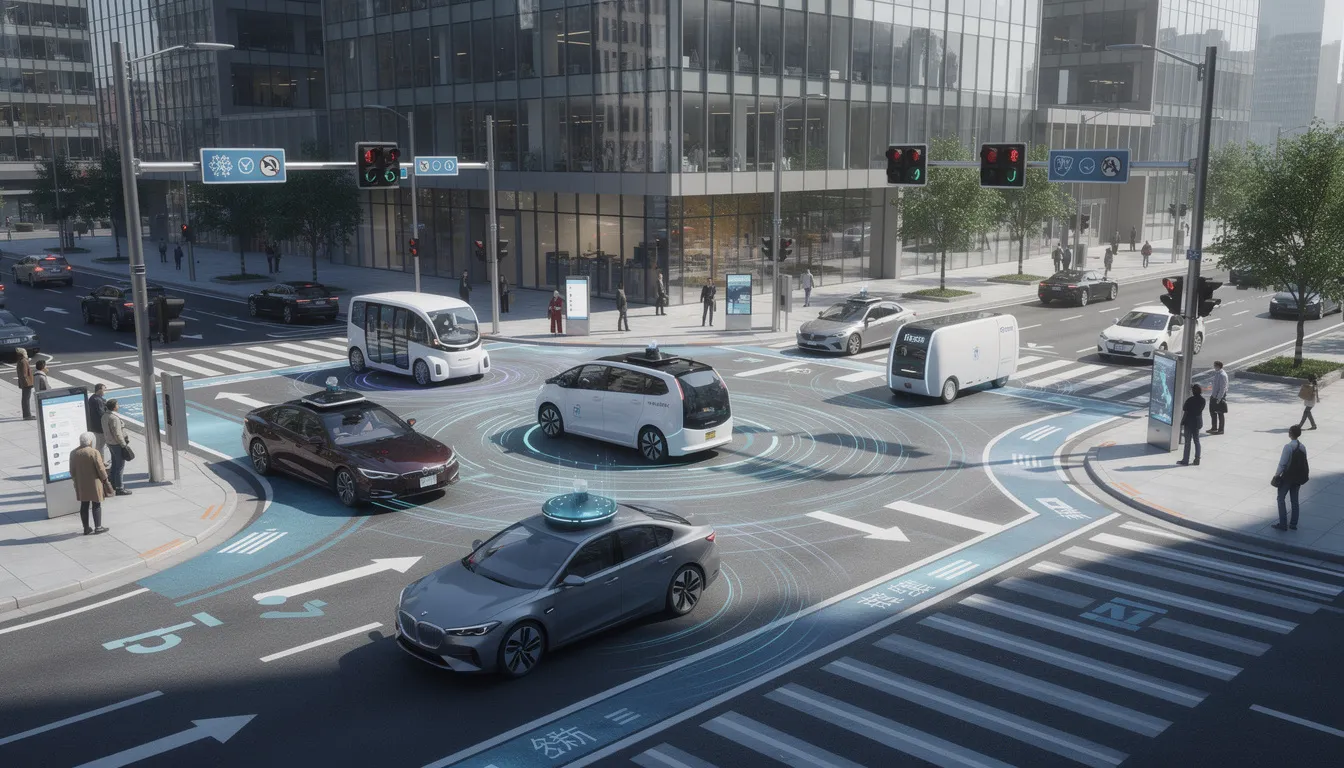
Commercial robotaxi services now operate in select cities (Waymo in the U.S., Apollo Go in China). AI-based route optimization and driver-assist features are standard in consumer vehicles.
Plausible 2030–2035 scenarios:
Autonomous vehicles common in certain zones (ports, campuses, dedicated city districts)
Logistics chains heavily automated from warehouse to last-mile delivery
“Smart city” applications controlling traffic lights, energy systems, and public transit based on real-time demand
AI managing public infrastructure raises governance questions: standardized testing regimes for self-driving systems, clear liability rules, and public transparency on algorithms affecting daily life.
Adoption will be uneven. Some cities and countries move faster due to regulatory flexibility and investment. Others lag due to legal, cultural, or infrastructural constraints. The autonomous vehicles revolution won’t happen uniformly across the globe.
Risks, Dangers, and Unintended Consequences
Transformative potential and risk are inseparable. AI can compress decades of scientific progress into years, but it can also magnify errors, bias, and misuse at scale. Understanding these dangers isn’t pessimism-it’s preparation.
The following subsections cover economic disruption, bias and fairness, misinformation/deepfakes, privacy and surveillance, and safety/security including autonomous weapons. For each risk, we highlight mitigation strategies and ai research directions under active development.
Job Disruption, Inequality, and the Future of Work
Recent estimates suggest 40–50% of tasks in certain occupations could be automated, impacting both white- and blue-collar roles-particularly routine cognitive tasks like data entry, legal research, and back-office processing.
Important distinctions:
Full job loss: Some roles disappear entirely
Task reshaping: Many jobs change significantly while persisting
New categories emerge: AI trainers, evaluators, governance specialists, AI-augmented creatives
Distributional concerns are serious. Certain regions, demographic groups, and education levels face more exposure to job displacement without strong reskilling and social-safety policies.
Concrete policy levers exist: publicly funded retraining, incentives for companies investing in worker upskilling, portable benefits, and experiments with income support where automation is rapid. The job market will look different-the question is whether we manage the transition humanely.
Bias, Fairness, and Social Harm
AI inherits and can amplify biases present in training data and institutional practices. Known issues exist in facial recognition, credit scoring, and hiring tools-systems that affect real opportunities for real people.
If unmitigated, potential harms include automated discrimination in access to jobs, loans, housing, or public services, disproportionately affecting marginalized communities.
Emerging responses include:
Fairness metrics and bias audits
Dataset documentation standards
Diverse evaluation teams
Impact assessments before deployment
Regulatory requirements for transparency in high-risk systems
Many regulations-the EU AI Act, sectoral guidelines in the U.S., ISO/IEC standards-now require human oversight in high-risk advanced ai systems. Bias reduction is an ongoing process, not a one-time technical fix.
Deepfakes, Misinformation, and Eroding Trust
Consumer-accessible generative ai tools can already generate realistic faces, voices, and videos. High-profile political and financial scams have used deepfakes to deceive victims and manipulate markets.
By the late 2020s, the volume and realism of synthetic media will make targeted disinformation trivially easy to produce at scale-threatening elections, markets, and interpersonal trust.
Countermeasures span multiple domains:
Type | Examples |
|---|---|
Technical | Watermarking, content provenance standards, detection models |
Legal | Clarifying liability for malicious deepfake creation |
Educational | Media literacy campaigns for digital assistants and real content |
The “liar’s dividend” problem compounds the challenge: even authentic evidence can be dismissed as “fake,” complicating journalism, accountability, and justice systems. When anything can be faked, nothing can be trusted without verification infrastructure. |
Data Privacy, Surveillance, and Shadow AI
Large-scale training on web and user data raises serious questions about consent, intellectual property, and leakage of sensitive information in model outputs.
Regulatory trends are tightening: data protection authorities investigating ai companies, the U.S. AI Bill of Rights principles, and stricter data transfer rules across borders.
Workplace “shadow AI” presents immediate risks. Employees pasting confidential data into public ai tools without approval creates legal and security exposure. Emerging best practices include:
Internal AI platforms with access controls
Red-teaming and security testing
Data minimization principles
Clear ethical guidelines on acceptable AI use
Broader surveillance concerns persist. Governments and corporations using AI for mass monitoring require robust legal safeguards and civic oversight to protect human biases against authoritarian overreach.
Autonomous Weapons, Security, and Long-Term Safety
Lethal autonomous weapons systems (LAWS) represent one of AI’s gravest risks. AI enables faster targeting and decision cycles in military contexts, raising questions that human hackers and traditional weapons never posed.
Ongoing international debates (UN forums, open letters by researchers) push for bans or strict regulation on certain autonomous weapons. The Chinese Communist Party, United States, and other major powers have different positions on these restrictions.
Cybersecurity risks compound the challenge:
AI-generated malware adapting to defenses
Social-engineering attacks at scale using personalized content
Automated vulnerability discovery in critical systems
Long-term alignment concerns grow more urgent. As ai systems become more capable and agentic, ensuring their goals remain aligned with human values and human instructions becomes a core research and ai policy challenge. International coordination on red lines, verification mechanisms, and crisis protocols is essential to prevent escalation due to misinterpreted or malfunctioning systems.
Regulation, Governance, and Global AI Politics
The 2020s are the decade when abstract AI ethics documents turn into binding laws, standards, and geopolitical strategies. This isn’t theoretical-it directly affects which ai products get built and where they launch.
Three themes dominate: emerging regulatory regimes, corporate governance and standards, and AI as both tool and object of geopolitical competition. Government support and regulation will shape ai development trajectories through 2035 and beyond.
Evolving Laws: From the EU AI Act to National Strategies
The EU AI Act’s risk-based approach includes:
Stricter rules for high-risk systems (healthcare, law enforcement, credit)
Restrictions on practices like mass biometric surveillance
Transparency requirements for ai applications in public services
Phased implementation from 2024–2026
U.S. developments follow a different path: executive orders on AI safety, sector-specific rules (healthcare, finance), and a more decentralized, agency-driven approach compared to the EU.
China’s regulatory trajectory combines content rules for generative ai, licensing requirements for model providers, and integration with industrial strategy-a different model of ai adoption than Western approaches.
National AI strategies worldwide commit billions to ai infrastructure, education, and research hubs. Canada, France, India, Saudi Arabia, and others are racing to adopt ai capabilities and develop local talent.
By 2030–2035, organizations operating globally will navigate a patchwork of overlapping and sometimes conflicting regimes-influencing which ai products they build and where they launch them.
Corporate Governance, Standards, and Responsible AI
Many large organizations now have AI ethics boards, internal policies, and model review processes-but implementation quality varies dramatically.
Emerging technical benchmarks and standards for safety, robustness, and transparency may evolve into routine evaluations similar to security audits. The ai index report and similar publications track progress across these dimensions.
Key documentation practices gaining traction:
Model cards describing capabilities and limitations
Data sheets documenting training data sources
Standardized impact assessments before deployment
Audit trails for high-stakes decisions
Consider a bank evaluating a powerful but opaque credit model. Without clarity on fairness metrics and monitoring tools, the model doesn’t get deployed-regardless of its ai performance. Responsible AI is moving from “nice-to-have PR” to a condition for contracts, insurance, and regulatory compliance.
Geopolitics, Competition, and Collaboration
The U.S.–China competition over AI chips, cloud infrastructure, and foundational models shapes global AI trajectories. Export controls on advanced semiconductors aim to slow competitors while securing supply chains.
AI standards and governance norms are becoming diplomatic tools. Countries vie to shape global rules in their image, influencing where capital and talent flow. The ai race isn’t just about technology-it’s about who sets the rules.
Multilateral efforts aim for minimum alignment:
AI safety summits establishing safety baselines
OECD AI principles for responsible development
G7 codes of conduct for advanced ai systems
The possibility of “AI blocs” with partially incompatible tech stacks and regulations could affect cross-border data flows and collaborative ai research. AI is both a strategic asset and a shared risk, making careful international engagement essential.
Living and Working with AI: How Individuals and Teams Can Prepare
The future of artificial intelligence isn’t only about governments and labs. It’s about how professionals, students, and citizens adapt day-to-day. Your personal lives and careers will be shaped by how well you embrace ai while maintaining critical judgment.
This section focuses on actionable guidance: what to learn, how to experiment safely, and how to evaluate AI news and products critically.

Skills, Careers, and Lifelong Learning
Develop AI literacy first. Understand what current systems can and cannot do-basic concepts like training data, hallucinations, and model limitations. You don’t need to become a machine learning engineer, but you need to be an informed user.
Focus on complementary human capabilities unlikely to be fully automated soon:
Complex problem-solving across domains
Cross-disciplinary thinking and creativity
Interpersonal communication and negotiation
Deep domain expertise in your field
Ethical judgment and context interpretation
Specific upskilling paths depend on your field: prompt engineering, data analysis, basic programming language skills, or domain-specific applications (legal tech, health informatics, educational technology).
Organizations should budget time and resources for structured upskilling programs. Simply dropping ai tools into workflows and hoping adoption happens organically doesn’t work. Managers and professionals who deploy or supervise ai systems need to understand ai governance basics-privacy, security, ethics, and accountability.
Using AI Tools Safely and Effectively
Treat AI as an assistant, not an oracle. Double-check critical outputs, cross-reference sources, and remain cautious about hallucinated facts. Digital assistants can be confidently wrong.
Data hygiene matters:
Avoid pasting sensitive information into public tools
Prefer enterprise-grade, governed platforms for confidential data
Know which ai tools are approved by your organization
Understand what happens to your inputs
Start with small, low-risk experiments: use AI to draft emails, summarize documents, brainstorm ideas, or generate code snippets. Gradually move to more complex use cases as confidence and understanding grow.
Organizations should create clear internal policies and training materials explaining which tools are approved, what data can be used, and how outputs should be reviewed. Effective users learn to design good prompts, provide context, and iterate-treating the interaction as a dialogue rather than a one-shot command.
Staying Informed Without Losing Your Sanity
AI news moves fast. Daily announcements, model releases, funding rounds, and speculative commentary can overwhelm anyone trying to ai could keep up.
The problem is structural. Many newsletters send daily emails not because major news happens daily, but because sponsors want to see “time spent” metrics. So they pad content with minor updates, sponsored headlines, and noise that burns your focus.
The solution is curated, low-noise sources focused on genuinely important developments: major model capabilities, new technology regulations, research breakthroughs, and large-scale deployments.
KeepSanity AI offers one concise weekly email with only the major AI news that actually happened. No ads, no sponsor padding-just signal covering business, models, ai tools, ai policy, and robotics.
Set a small, regular time block-20–30 minutes per week-to digest curated updates and reflect on implications for your organization or career. Steady, sustainable learning beats fear-driven compulsive checking in a rapidly changing field.
Conclusion: Choosing the AI Future We Want
The future of artificial intelligence is not predetermined. The same technologies that can accelerate science, improve health, and boost productivity can also deepen inequality, spread misinformation, and strain democracies. The outcome depends on choices made by governments, corporations, researchers, and individuals.
The main near-term trends are clear: multimodal, agentic, embedded, and more efficient AI will reshape how we work and live. The critical levers-regulation, corporate governance, public awareness, and education-will determine whether this transformation benefits humanity broadly or concentrates gains while distributing harms.
You’re not a spectator in this future. As a voter, professional, creator, or user, you can push for responsible deployment and thoughtful ai policy. Your decisions about which ai services to use, which ai companies to support, and which skills to develop all contribute to shaping ai’s future.
For those who want to track the real progress of this future-without drowning in daily hype-subscribe to KeepSanity AI’s weekly newsletter for focused, high-signal AI coverage that respects your time and intelligence.
FAQ
The following questions address common concerns not fully covered above, focusing on timelines, personal impact, and practical next steps.
Will AI take over most jobs by 2035?
AI is likely to automate many tasks within jobs rather than eliminating all jobs themselves. The biggest impact by 2035 will hit routine cognitive and repetitive roles-call centers, data entry, basic legal research, and back-office processing.
History suggests new roles emerge alongside automation. Previous technological shifts created categories of work that didn’t exist before. But transitions can be painful without strong retraining, education, and social policies to support displaced workers.
The practical response is to proactively learn how ai tools work in your field and focus on complementing, not competing with, automation. Build skills in areas where human judgment, creativity, and interpersonal connection matter most.
How close are we to superintelligent AI?
While models have advanced rapidly on benchmarks since the 2017 transformer breakthrough, current systems still struggle with robust reasoning, long-term planning, and reliability. Artificial general intelligence that matches human capabilities across all domains remains uncertain in timing.
Expert opinions vary widely on superintelligence timelines. Many leading researchers emphasize safety research and governance precisely because of this uncertainty-not because they believe superintelligence is imminent, but because preparing early matters if it eventually arrives.
Focus on concrete challenges in the 2020s–2030s: safe deployment, bias mitigation, and governance. Follow long-term safety developments through trusted, curated sources rather than speculative hype.
What should students study today to be relevant in an AI-heavy future?
A balanced approach works best: fundamentals (math, statistics, basic programming), domain expertise (biology, law, design, healthcare), and human skills (communication, collaboration, ethics).
Not everyone needs to be an AI engineer. Growing demand exists for people who can bridge AI with fields like healthcare, policy, education, and the arts. The ability to understand what AI can do and apply it meaningfully in a specific domain is increasingly valuable.
Build a portfolio of projects that use ai tools meaningfully-showing adaptability and real-world problem-solving ability rather than just theoretical knowledge.
Can small businesses and individuals really benefit from AI, or is it just for big tech?
Falling costs and smaller models mean powerful AI is increasingly accessible to startups, small firms, and solo professionals via cloud APIs and off-the-shelf generative ai tools.
Concrete examples for small businesses:
Automating bookkeeping and data entry tasks
Improving customer support with chatbots
Enhancing marketing content creation
Analyzing sales data to identify patterns and opportunities
The key challenge is smart ai adoption-choosing the right tools, respecting data privacy, and not over-engineering solutions. Start with genuine pain points rather than implementing AI for its own sake.
How can I tell which AI news actually matters?
Prioritize news about major capability shifts, large deployments, significant regulations, and credible research breakthroughs. Minor product updates and hype cycles rarely affect your decisions.
Evaluate sources for transparency, expertise, and incentives. Sponsored content has different motivations than independent analysis. Check whether predictions are specific and falsifiable or vague and hedged.
KeepSanity AI offers one option: a weekly digest focusing only on major, high-signal developments across generative models, business, ai policy, and research-helping you analyze massive amounts of news without information overload. Lower your shoulders. The noise is gone. Here is your signal.