Deep Artificial Intelligence
Deep artificial intelligence is reshaping how we search, create, diagnose, and discover. From the chatbot answering your questions to the recommendation engine picking your next show, powerful neural networks are working behind the scenes. But what exactly is “deep AI,” and why has it become the engine of modern technology?
This guide breaks down the essentials: what deep artificial intelligence means, how it differs from older AI approaches, the architectures that make it work, and where it’s already transforming industries. You’ll also learn about its real limitations and how to follow this fast-moving field without burning out.
Key Takeaways
“Deep artificial intelligence” is an informal label for advanced deep learning systems-transformers, diffusion models, and other multi-layer neural networks-that sit within the broader AI → ML → DL hierarchy.
The deep learning revolution emerged around 2012–2015, driven by GPU hardware, massive datasets, and breakthrough architectures like AlexNet, ResNet, GANs, and transformers.
Deep AI now dominates computer vision, speech recognition, natural language processing, drug discovery, recommendation systems, robotics, and scientific simulations.
While deep AI excels at automatic feature learning, scaling, and generative capabilities, it struggles with data hunger, opacity, brittleness, bias, and ethical concerns.
Staying informed about deep AI doesn’t require daily overwhelm-services like KeepSanity AI deliver only the major developments worth your attention each week.
What Is Deep Artificial Intelligence?
Deep artificial intelligence refers to cutting-edge AI systems built on deep neural networks-typically containing four or more layers-that can perceive patterns, exhibit reasoning-like behavior, and generate new content. Unlike the rule-based expert systems of earlier decades, these models learn directly from data rather than following hand-written instructions.
The relationship works like nested boxes. Artificial intelligence is the broadest category: any system that performs tasks we consider intelligent. Machine learning is a subset where systems learn patterns from data. Deep learning narrows further to multi-layer neural networks that automatically extract hierarchical features. The relationship between AI, machine learning, and deep learning can be visualized as a hierarchy, with deep learning being a specialized type of machine learning. Finally, generative AI and foundation models represent specialized deep systems focused on producing novel text, images, or code. When people say “deep AI,” they’re usually pointing to this inner stack of deep learning and generative models.
You interact with deep AI daily, often without realizing it. When ChatGPT writes a response, it’s using a transformer architecture trained on billions of tokens. When Midjourney or DALL·E generates an image from your text prompt, diffusion models are iteratively refining noise into coherent visuals. When Netflix suggests what to watch next, deep networks analyze billions of user interactions-driving over 80% of viewing decisions through embeddings and collaborative filtering.
What separates deep AI from older approaches is this ability to learn complex patterns without manual feature engineering. Early chess engines followed exhaustive if-then trees programmed by humans. AlphaGo, by contrast, combined convolutional neural networks with Monte Carlo tree search, learning from millions of self-play games to defeat world champion Lee Sedol in 2016. The game of Go has roughly 10^170 possible positions-far too many for hand-coded rules. Deep AI learned its way through.

How Deep Artificial Intelligence Fits into the AI Landscape
Think of the AI landscape as a Matryoshka doll. The outermost doll is artificial intelligence itself-any machine-based system that performs tasks through data analysis and logic. Nested inside is machine learning, where systems create algorithms from data patterns rather than explicit programming. Deeper still is deep learning, which uses artificial neural networks with multiple hidden layers to automatically discover features. At the core sits generative AI and large language models, specialized deep systems that don’t just analyze but create.
Each layer has distinct characteristics:
Artificial intelligence encompasses any system performing tasks that typically require human intelligence. This includes everything from route-planning algorithms to fraud detection systems using predefined thresholds. A rule-based credit scoring system that flags applications based on explicit criteria is AI, but it’s not learning from data.
Machine learning involves models that recognize patterns from historical data. A model predicting house prices based on features like square footage and location is machine learning. These machine learning algorithms often rely on hand-engineered features-humans deciding which variables matter.
Deep learning automates the feature discovery process. Instead of humans specifying that edges matter for image recognition, deep learning models figure this out themselves. Deep neural networks with multiple layers learn increasingly abstract representations: edges in early layers, textures in middle layers, objects in deep layers.
Generative AI uses deep learning architectures to create new content. Rather than classifying an image, a diffusion model generates one. Rather than summarizing text, a large language model writes original prose, code, or analysis.
Consider fraud detection as a practical example. A rule-based system might flag transactions over $10,000 from new accounts. A traditional machine learning model might learn patterns from labeled fraud cases, using features that analysts defined. A deep learning approach processes raw transaction data, automatically discovering complex correlations humans might miss-unusual timing patterns, subtle behavioral sequences, interactions between multiple variables.
Deep learning became necessary because manual feature extraction couldn’t scale. Around 2012, researchers realized that hand-crafted features were too brittle for the complexity of images, speech, and natural language processing at web scale. The shift to deep networks that learn their own representations unlocked capabilities that traditional methods couldn’t match.
Core Building Blocks of Deep AI: Neural Networks and Architectures
An artificial neural network is a computational structure inspired by the human brain, though the analogy is loose. Layers of interconnected nodes-artificial neurons-process input data through weighted sums followed by nonlinear activation functions. Each layer transforms the signal, and depth allows the network to model increasingly complex patterns. Early layers might detect simple features; deeper layers combine these into abstract concepts.
The basic structure follows a consistent pattern. An input layer receives raw data-pixels, audio samples, or token embeddings. Multiple hidden layers process this data through learned transformations. An output layer produces the final prediction or generation. In a vision model, early layers learn to recognize patterns like edges and gradients. Middle layers combine these into textures and shapes. Deep layers recognize objects, faces, or scenes. This hierarchical representation is what makes deep learning methods so powerful for unstructured data.
Key Architectures
Convolutional neural networks (CNNs) revolutionized computer vision. By sharing weights through sliding filters, CNNs achieve translation invariance-they can recognize a cat whether it’s in the corner or center of an image. AlexNet’s 2012 ImageNet victory slashed error rates from 26% to 15%. ResNet-152, with its 152 layers and skip connections, pushed error to just 3.6%. Today, CNNs power medical image analysis, detecting diabetic retinopathy with accuracy surpassing radiologists, and enable object detection in self driving cars.
Recurrent neural networks (RNNs) handle sequential data by maintaining internal state across time steps. However, basic RNNs struggle with long sequences due to vanishing gradients. Successors like LSTM and GRU networks introduced gating mechanisms to control information flow, enabling early speech recognition systems and machine translation before transformers took over.
Transformer models discarded recurrence entirely. The 2017 paper “Attention Is All You Need” introduced self-attention mechanisms that compute relevance scores across all tokens in parallel. This architecture scales efficiently and powers GPT-3’s 175 billion parameters, BERT’s bidirectional context understanding, and most modern large language models.
Graph Neural Networks (GNNs) propagate information across graph structures, making them essential for drug discovery and molecular modeling. AlphaFold2 uses graph-based reasoning to predict protein structures for 200 million entries. AtomNet screens molecular compounds for pharmaceutical properties.
Generative models create new data. Generative adversarial networks pit a generator against a discriminator in an adversarial game, producing photorealistic faces in systems like StyleGAN. Diffusion models reverse a noising process, iteratively refining random noise into coherent images-the approach behind Stable Diffusion and DALL·E.
The deep learning process for training these networks relies on backpropagation-computing gradients of a loss function through the chain rule-and optimization via stochastic gradient descent or variants like Adam. This learning process typically requires massive amounts of training data, though self-supervised approaches can reduce the need for labeled data by learning from the structure of the input data itself.
The Deep Learning Revolution: From GPUs to Transformers
Today’s deep AI moment didn’t arrive overnight. It’s the product of a decade-long revolution driven by three forces: abundant data, powerful compute, and algorithmic innovation.
2006–2009: The resurgence began with Geoffrey Hinton’s deep belief networks, which used restricted Boltzmann machines for unsupervised pretraining. These techniques showed that deep networks could be trained effectively, countering decades of skepticism about neural network depth.
2012: The inflection point. AlexNet, trained on two NVIDIA GTX 580 GPUs over five days, won the ImageNet competition by cutting top-5 error nearly in half. This demonstrated that computational power combined with large datasets could unlock unprecedented capabilities. Industry investment exploded-Google acquired DeepMind in 2014 for $500 million.
2014–2015: ResNet introduced skip connections, enabling training of networks with over 1,000 layers while winning ImageNet at 3.57% error. Ian Goodfellow introduced GANs, opening the door to realistic image synthesis. These deep learning architectures proved that very large datasets and deeper networks consistently improved performance.
2016: AlphaGo defeated world champion Lee Sedol 4-1 at Go, combining deep policy and value networks with Monte Carlo tree search. The system trained on 30 million human games plus extensive self-play, demonstrating that deep learning could master tasks previously thought to require human intelligence.
2017: The transformer architecture publication changed everything. By replacing recurrence with self-attention, transformers enabled massive parallel training on text data. This unlocked the scaling that would define the next era.
2018–2021: Large language models emerged in succession: GPT-2 (1.5 billion parameters), BERT (340 million), GPT-3 (175 billion). Each demonstrated emergent capabilities-few-shot learning, reasoning-like behavior, code generation-that smaller models lacked. Diffusion models like DALL·E brought similar advances to image generation.
2022–2023: ChatGPT’s launch reached 100 million users in two months, powered by GPT-3.5 fine-tuned with reinforcement learning from human feedback. Generative AI moved from research to mainstream products. Efficient alternatives like Mamba offered linear-time sequence processing, addressing transformer limitations.

Hardware made this possible. A single NVIDIA H100 delivers 4 petaflops for inference. Clusters of thousands of GPUs train frontier models in weeks. Google’s TPUs, custom AI accelerators, and cloud infrastructure transformed deep learning from academic research into industry-scale deployment.
Scaling laws, formalized around 2020, showed that loss decreases predictably with more compute, more data, and larger models. The Chinchilla study in 2022 optimized this relationship, showing that 70 billion parameters trained on 1.4 trillion tokens outperformed larger but undertrained models. These laws now guide investments like xAI’s Memphis Supercluster with 100,000 H100 GPUs.
Real-World Applications of Deep Artificial Intelligence
Since roughly 2015, deep AI has moved from research labs into mainstream products across virtually every industry. The systems that once impressed researchers now power everyday experiences.
Computer vision applications span from image classification to real-time object detection. Medical imaging systems detect diabetic retinopathy and cancer with accuracy matching or exceeding specialists. Tesla’s Autopilot and Waymo’s perception systems identify pedestrians, vehicles, and obstacles across millions of miles driven. Google’s Visual Search processes over a billion queries daily, matching photos to products, landmarks, and information.
Speech recognition has transformed how we interact with devices. Virtual assistants like Siri, Google Assistant, and Alexa use deep networks for real-time automatic speech recognition. OpenAI’s Whisper achieves 5.6% word error rate across 99 languages. Voice cloning and synthesis enable new applications in accessibility, entertainment, and communication-though they also raise concerns about deepfakes.
Natural language processing powers translation, summarization, and generation. Google Translate’s 2016 neural update boosted quality by 60%. GitHub Copilot generates 46% of code in VS Code sessions, accelerating development workflows. Document summarization, sentiment analysis, and question-answering systems handle human language at scale, enabling applications from customer support to legal research.
Generative media tools have democratized content creation. Midjourney and DALL·E produce images from text descriptions, used by designers, advertisers, and artists. Video synthesis tools like Sora generate minute-long clips coherent across physics and motion. Studios use these tools for concept art, storyboarding, and rapid prototyping.
Drug discovery and materials science benefit from deep AI’s ability to process molecular and structural data. AlphaFold2 predicted protein structures for 200 million entries, accelerating biological research. GNoME discovered 2.2 million stable crystal structures, identifying 380,000 new materials. AtomNet screens millions of compounds for pharmaceutical properties, compressing years of laboratory work into computational searches.
Recommendation systems shape what billions of people see online. Netflix’s deep networks personalize suggestions for 250 million subscribers, reportedly lifting retention by 20%. TikTok’s algorithm serves 1.7 billion users through multi-tower models that learn from engagement signals. E-commerce platforms use similar approaches for product recommendations.
Finance and security applications include fraud detection blocking billions in losses annually at companies like PayPal. Anti-money laundering systems identify suspicious patterns across transaction networks. Risk scoring models evaluate creditworthiness, trading opportunities, and insurance claims.
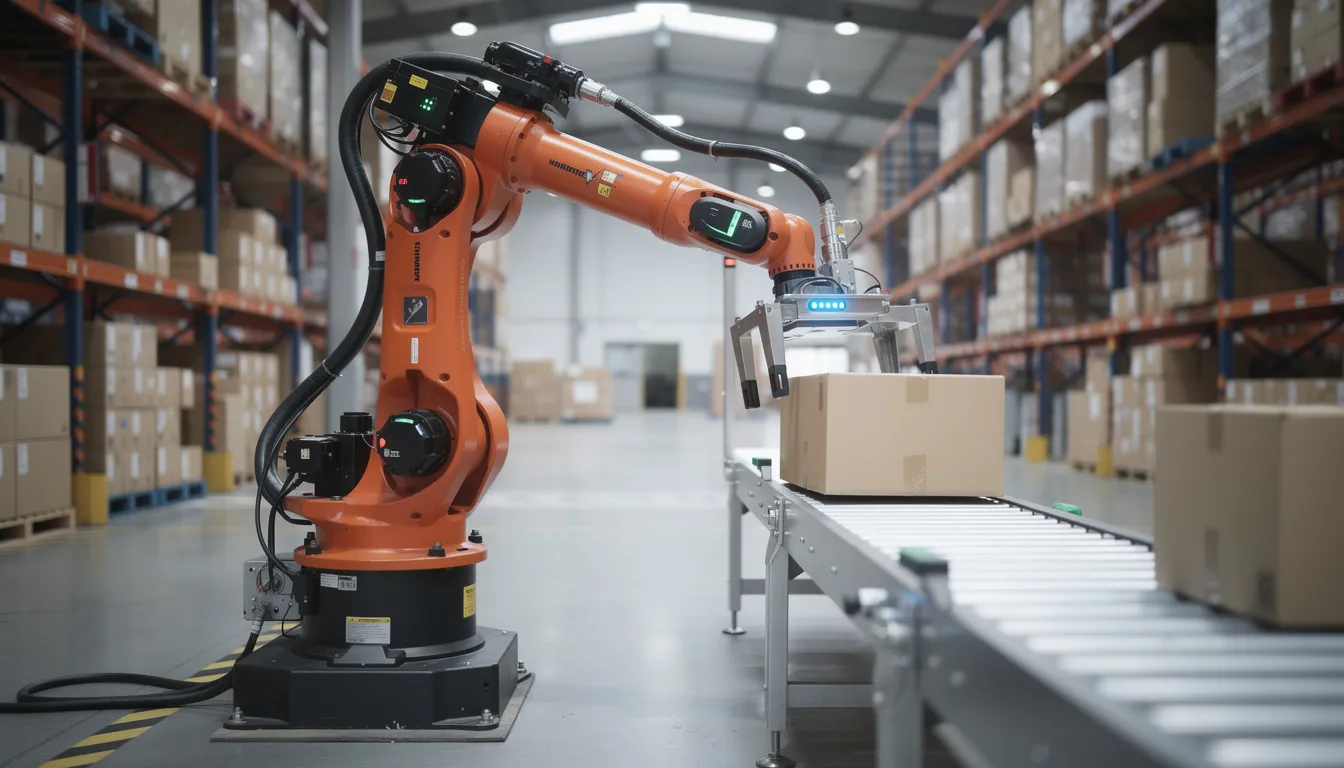
Robotics and control increasingly rely on deep learning for perception and action. Amazon’s warehouse robots use imitation learning to achieve faster picking speeds. Autonomous drones navigate complex environments. Industrial robots learn from human demonstrations rather than explicit programming.
For everyday users, this translates to better search results, more relevant content, and more accurate medical diagnostics. For organizations, it means efficiency gains, new product possibilities, and competitive advantages-though also new risks to manage.
Capabilities and Limits of Deep AI
Deep AI systems excel at pattern recognition, large-scale prediction, and content generation. But they are not general intelligence, and understanding their sharp edges matters as much as appreciating their strengths.
Automatic Feature Learning
Automatic feature learning eliminates the need for hand-crafted representations. Before CNNs dominated computer vision, researchers spent years designing edge detectors and feature descriptors. Deep networks learn these representations automatically from raw data, often discovering features humans never would have specified. On ImageNet, where human error sits around 5%, deep learning techniques now achieve error rates below 2%.
Scaling and Benchmarks
Scaling yields superhuman benchmarks on specific tasks. GPT-4 scores 86% on MMLU, a comprehensive test of knowledge across dozens of domains. Deep learning models trained on sufficient data points consistently outperform prior approaches, following predictable scaling laws.
Transfer and Fine-Tuning
Transfer and fine-tuning allow foundation models to adapt to new tasks with relatively little data. CLIP achieves 76% zero-shot accuracy on ImageNet by learning from text-image pairs-no task-specific training required. Organizations can fine-tune open models like Llama on thousands of domain examples rather than collecting millions of raw samples.
Data Hunger and Compute Costs
Data hunger and compute costs remain significant data requirements. GPT-3 trained on 45 terabytes of text. Frontier models require clusters of thousands of GPUs costing hundreds of millions of dollars. Even with computational resources becoming more accessible, building truly novel models from scratch remains prohibitive for most organizations.
Opaqueness
Opaqueness makes these models difficult to interpret. Saliency maps and attention visualizations reveal some of what models focus on, but fully explaining why a deep network made a specific prediction remains an open problem. In high-stakes domains like healthcare and criminal justice, this black-box nature creates accountability challenges.
Fragility and Adversarial Attacks
Fragility and adversarial attacks expose unexpected vulnerabilities. Small, carefully designed perturbations-invisible to humans-can fool image classifiers with high success rates. Prompt injection can mislead language models into ignoring instructions or revealing training information. These attacks demonstrate that deep networks recognize patterns in ways fundamentally different from human perception.
Bias and Fairness
Bias and fairness issues persist because models inherit patterns from training data. Facial recognition systems show error rates 34% higher on dark-skinned faces. Hiring models have exhibited gender discrimination. Generated text and images can reproduce stereotypes present in web-scraped data.
Hallucinations and Unreliability
Hallucinations and unreliability affect language models in particular. LLMs confidently generate incorrect facts, fabricated citations, and plausible-sounding nonsense. Estimates suggest hallucination rates of 15-30% on factual queries, making human oversight essential for any high-stakes application.
Emerging research addresses these limitations through mechanistic interpretability (understanding individual neurons and circuits), adversarial training (improving robustness by 50% in some cases), reinforcement learning from human feedback (aligning outputs with human preferences), and hybrid approaches combining deep perception with symbolic reasoning.
Training Deep AI Systems: Data, Compute, and Engineering
Behind every impressive deep AI system is a long pipeline: data collection, cleaning, labeling (or self-supervised learning), model design, training, evaluation, and deployment. Understanding this process demystifies how these systems actually work.
The Role of Data
Training data comes in many forms. ImageNet provided 14 million labeled images across thousands of categories, enabling the computer vision revolution. LibriSpeech offers 1,000 hours of transcribed audio for speech recognition research. Web corpora like The Pile (800GB of diverse text) and C4 (trillions of filtered tokens) fuel language model training.
Human annotation remains critical despite advances in unsupervised learning. Platforms like Scale AI employ over 100,000 workers for image labeling, content rating, and reinforcement learning from human feedback. This raises ethical concerns about labor conditions-workers often earn $2-5 per hour-and consent issues around web-scraped content. The New York Times sued OpenAI in 2023 over the use of millions of articles in training data.
The Training Process
Training follows a conceptually simple loop:
Initialize model parameters randomly.
Forward pass: Feed batches of input data through the network to compute predictions.
Loss computation: Compare predictions with ground truth (or self-supervised targets).
Backpropagation: Compute gradients showing how to adjust weights to reduce error.
Update: Apply gradients via optimization algorithms like Adam.
Repeat for many epochs until validation performance plateaus.
GPT-4 reportedly required around 10^25 floating-point operations-a scale requiring months of training on specialized hardware.
Hardware Requirements
Specialized hardware makes deep learning feasible. NVIDIA’s H100 GPUs feature 141GB of high-bandwidth memory and can process massive batch sizes. Google’s TPU v5p pods of 8,960 chips achieve exaflop-scale computation. Cloud providers offer these resources via AWS Trainium, Azure NDv5 clusters, and Google Cloud TPUs.
Deployment Engineering
Research models don’t automatically become production services. Engineers convert trained models into APIs, optimize for latency through techniques like quantization (reducing precision from 32-bit to 8-bit for 4x speedups), and distill large teacher models into smaller student models that retain 95% of performance at a fraction of the size. Edge deployment enables running models on mobile devices and embedded systems where connectivity or latency constraints matter.
Ethics, Data Practices, and Societal Impact
Deep AI raises new ethical questions due to its scale, opacity, and influence over information flows. These aren’t abstract concerns-they affect real people and require thoughtful governance.
Data Collection and Labor
The invisible labor behind AI systems deserves attention. Crowdsourced workers label images, rate model outputs, and filter harmful content. This work often occurs in lower-wage countries with minimal benefits or protections. The polished interfaces of AI products rarely acknowledge this human foundation.
Data sourcing raises consent and copyright questions. Models trained on web-scraped content include copyrighted books, code repositories, and images often without permission. GitHub Copilot faces lawsuits over training on public repositories. Artists protest their work appearing in generative model outputs without compensation.
Key Ethical Concerns
Privacy risks emerge because models trained on sensitive data can memorize and regurgitate personal information. Research shows LLMs reproduce approximately 1% of training data verbatim under certain prompting conditions.
Bias and discrimination manifest in consequential decisions. Amazon scrapped a hiring tool in 2018 after discovering it penalized women. Lending models, predictive policing systems, and medical diagnosis tools all risk perpetuating historical inequities embedded in training data.
Misinformation and deepfakes become easier to produce. According to Sensity AI, 95% of deepfake content is non-consensual pornography. Synthetic media can manipulate political discourse, enable fraud, and erode trust in authentic information.
Regulatory Responses
Governance frameworks are emerging. The EU AI Act (enforcement beginning in 2024) establishes risk categories, requiring transparency obligations and risk assessments for high-risk applications like biometric identification. The US Executive Order 14110 mandates safety testing for frontier models. Industry initiatives include model cards documenting capabilities and limitations, red-teaming to identify vulnerabilities, and responsible AI guidelines.
Developing and deploying deep AI responsibly requires multidisciplinary teams-engineers, ethicists, legal experts, domain specialists-working together rather than treating ethics as an afterthought.
Staying Sane While Following Deep AI: The KeepSanity Perspective
Deep AI evolves at a pace that makes anyone feel perpetually behind. NeurIPS 2024 featured over 7,000 papers. Major labs release new models monthly. Twitter threads, Discord channels, and newsletters compete for attention with an endless stream of updates.
Most AI newsletters compound the problem rather than solving it. They send daily emails-not because there’s major news every day, but because frequency keeps sponsors happy. The result is minor updates that don’t matter, sponsored headlines you didn’t ask for, and noise that burns your focus and energy. You end up with a piling inbox, rising FOMO, and endless catch-up.
KeepSanity takes a different approach:
One email per week with only the major AI developments that actually happened. No daily filler to impress sponsors, no padding with trivial updates.
Zero ads. The curation serves readers, not advertisers. You get signal about what matters in deep AI-frontier model releases, significant research results, regulatory changes, major product shifts.
Smart linking. When covering research papers, KeepSanity points to accessible reading formats and brief summaries. You can go deeper on what interests you without wading through dense PDFs for everything.
Scannable categories. Business, product updates, models, tools, resources, community, robotics, trending papers-organized so you can skim everything in minutes and drill down on what’s relevant to your work.
Top AI teams at companies like Adobe, Surfer, and Bards.ai subscribe to stay informed without sacrificing focus. For anyone who needs to track deep artificial intelligence but refuses to let newsletters steal their sanity: the noise is gone. Here is your signal.

FAQ about Deep Artificial Intelligence
Is deep artificial intelligence the same as artificial general intelligence (AGI)?
No. “Deep artificial intelligence” as used in this article refers to powerful deep learning systems-large language models, diffusion models, transformers-that excel at specific tasks or patterns within their training data. Current deep AI systems are narrow: they lack human-level general reasoning, common sense, and autonomous goal-setting.
Some research labs pursue AGI using deep learning as the primary path, scaling models and adding capabilities incrementally. But there’s no consensus on when-or whether-this approach will achieve true general intelligence. Current systems can fail surprisingly on problems trivially easy for humans, perform inconsistently across domains, and lack the flexible reasoning that characterizes human cognition.
Do I need huge datasets and GPU clusters to use deep AI in my organization?
Only if you’re building frontier-scale models from scratch. For most organizations, that’s unnecessary and impractical.
Practical paths include using existing foundation models via APIs-GPT-4o costs $2.50 per million input tokens. You can fine-tune open-source models like Llama on modest datasets using cloud GPUs that cost under a dollar per hour. Domain-specific models like BioBERT or legal-focused LLMs may already fit your use case.
The bigger barriers are often data quality and integration rather than raw scale. A well-curated dataset of thousands of high-quality examples often outperforms millions of noisy samples. Start with narrow, high-value use cases where you have good data rather than attempting to build general-purpose systems.
How does deep AI affect jobs and the future of work?
Deep AI already automates or accelerates tasks in coding, content creation, customer support, analysis, and design. GitHub Copilot makes developers 55% faster on certain tasks. Writing assistants draft emails and reports. Support chatbots handle routine inquiries.
The impact operates at the task level more than the role level. Data analysts become AI-augmented decision-makers rather than disappearing entirely. Writers focus more on strategy, editing, and judgment while offloading first drafts. Most roles will transform rather than vanish-humans concentrate on problem framing, oversight, and complex judgment while AI handles routine execution.
Individuals benefit from investing in complementary skills: data literacy, effective prompting, systems thinking, and domain expertise combined with AI tools. The goal isn’t competing with AI but leveraging it.
Can small teams or startups meaningfully innovate in deep AI, or is it only for big tech?
Small teams can absolutely innovate-just not by training frontier models from scratch. The opportunities lie elsewhere:
Novel applications and user experiences built on existing models. Perplexity created an AI-powered search experience. Legal tech startups build specialized copilots for contract review. Medical imaging companies fine-tune vision models for specific diagnostic tasks.
Domain-specific data curation creates defensible advantages. A startup with high-quality, well-labeled data in a niche domain can outperform generic models on relevant tasks.
Efficient tooling and evaluation matters as the ecosystem matures. Open-source communities release competitive models. Startups build better interfaces, evaluation frameworks, and deployment pipelines.
Deep AI innovation increasingly centers on smart use and integration rather than raw model size. Keeping up with only the important developments-via services like KeepSanity-helps small teams allocate scarce time to what actually matters.
How can non-technical leaders make good decisions about adopting deep AI?
Start with focused questions rather than technology-first thinking:
What concrete business problems or workflows could deep AI improve right now?
Do we understand the risks-privacy, bias, reliability-for each proposed use?
How will we measure success and monitor failures in production?
Form cross-functional working groups including product, legal, security, and domain experts rather than delegating everything to IT. The best implementations combine technical capability with deep understanding of the problem context.
Begin with low-risk, high-value pilots: internal document search, meeting summarization, support draft generation. These build organizational competence before moving to high-stakes decisions. Establish clear governance policies on acceptable uses, data handling, and model evaluation-even when using third-party APIs. Vendor risk assessment matters as much as internal capabilities.