Is AI Real? Understanding What’s Behind the Hype
Introduction
This article is for professionals, decision-makers, and anyone curious about the reality of AI technology. Understanding what is truly real in artificial intelligence (AI) matters now more than ever-to make informed decisions about technology adoption, policy, and personal use. As AI becomes embedded in everything from business operations to daily life, separating fact from fiction is essential for protecting your job, your data, and your organization’s future.
Key Takeaways
AI is absolutely real as deployable software and hardware that has been operational since the 1950s-systems like AlphaGo, GPT-4, and Gemini 2.5 run in production environments serving millions of users daily.
No AI in 2026 is conscious, self-aware, or truly intelligent in the human sense; these are sophisticated pattern recognizers trained on vast amounts of data, not digital minds.
Many products marketed as artificial intelligence are actually simple automation dressed up with buzzwords (“AI-washing”), so distinguishing real machine learning from rule-based scripts matters.
Real AI can beat world champions at Go, translate 133 languages in real time, assist with self driving cars in select cities, and generate human like text and code-but it still hallucinates facts and lacks genuine understanding.
KeepSanity AI (keepsanity.ai) delivers only significant AI advances in one weekly email, helping readers track real progress versus marketing noise without daily inbox overload.
What Do We Really Mean by “Is AI Real?”
Artificial intelligence (AI) is the capability of computational systems to perform tasks typically associated with human intelligence, such as learning, reasoning, problem-solving, perception, and decision-making.
The question “is AI real?” probes something fundamental: are today’s AI systems genuinely intelligent, or are they sophisticated software tricks wrapped in science fiction dreams? In 2026, with artificial intelligence AI embedded in 40% of enterprise applications according to Gartner predictions, the answer affects hiring decisions, lending algorithms, and policies that touch billions of lives.
When people ask about artificial intelligence, they’re usually mixing three distinct meanings. First, there’s real running code and hardware-systems like GPT-4 serving 100 million weekly users through Azure, Gemini 2.5 powering Google Search with multimodal reasoning, and GitHub Copilot Search accelerating developer queries by 55%. These exist. You can use them right now.
Second, there’s the marketing buzzword. A 2024 Forrester analysis found that 70% of customer service tools branded as “AI” are actually if-then chatbots matching keywords without any adaptive learning. They’re decision trees with better branding.
Third, there’s science fiction-HAL 9000 from 2001: A Space Odyssey, Terminator’s Skynet, the idea of conscious machines that evolve beyond human control. As of 2026, no evidence supports any deployed system achieving such thing.
This article separates these layers so you can answer the question for yourself. When ChatGPT launched in November 2022 and reached 1 million users in five days, it sparked a generative AI boom worth $2.7 billion in OpenAI revenue by 2024. When the EU AI Act was finalized in March 2024-classifying systems by risk and mandating transparency-regulators pushed back against the hype. Understanding both developments helps you read headlines critically rather than reactively.
How Modern AI Actually Works (In the Real World)
How AI Models Are Trained
Modern AI is built on machine learning and deep learning, processing petabytes of data on specialized hardware. There’s no magic, no secret sauce-just mathematics, computing power, and scale that would have seemed impossible twenty years ago.

Here’s what actually happens when companies build an AI model like GPT-4: thousands of GPUs (in this case, approximately 25,000 NVIDIA A100s) process filtered internet text, code, and images over months. The system learns statistical correlations through transformer architectures-deep neural networks that weigh token sequences using attention mechanisms. It’s not programming explicit rules. It’s letting the model identify patterns from training data at a scale humans couldn’t manually specify.
Classic Rule-Based AI vs. Modern AI
The milestones tell the story of how we got here:
Year | Milestone | Significance |
|---|---|---|
2012 | AlexNet wins ImageNet | Deep learning halves image recognition error rates to 15% |
2016 | AlphaGo beats Lee Sedol | AI achieves superhuman performance in Go (4-1 victory) |
2020 | GPT-3 launches | 175 billion parameters demonstrate few-shot learning on 45TB of data |
2023 | GPT-4 releases | Doubles benchmark scores, 90th percentile on Bar Exam |
2024 | Gemini 1.5 arrives | 1 million token context windows for video and document analysis |
2025-2026 | Gemini 2.5 emerges | Agentic memory for multi-step tasks, 2M+ token contexts |
This contrasts sharply with classic rule-based AI from the 1980s and 1990s. Expert systems like MYCIN diagnosed infections using 500 hardcoded rules-and plateaued during “AI winters” because they couldn’t adapt to new data. A programmer had to manually update every rule.
Neural networks work differently. They propagate errors backward through layers via gradient descent, adjusting millions or billions of weights to minimize prediction loss. Transformers parallelize this process efficiently through self-attention layers that compute relevance scores across entire sequences. Reinforcement learning lets AI agents like AlphaZero learn through self-play rewards, achieving superhuman chess in just 24 hours.
The key insight: modern AI doesn’t follow instructions like traditional computer code. It learns statistical patterns from historical data and generalizes them-which is why it can complete tasks never explicitly programmed, but also why it fails on novel reasoning that requires true understanding.
Real AI vs. Fake AI (Marketing, Hype, and AI-Washing)
AI-washing surged after the 2022 ChatGPT explosion. McKinsey estimated that 60% of “AI” claims in 2023 involved non-learning automation designed to attract a share of the $200 billion flowing into AI investments. The term sounds good in pitch decks.
Here’s what fake or overstated AI looks like in practice:
Zendesk chat widgets using scripted decision trees that match keywords without any model updates
Tableau dashboards executing static SQL queries mislabeled as “AI analytics”
Photoshop’s 2018 “AI enhancements” that relied on fixed filters until true generative infill arrived in 2023
Chatbots that follow rigid flowcharts with no ability to handle unexpected inputs
Real AI in industry practice means systems that use machine learning to change behavior based on new data. The distinction matters because one category actually improves and adapts, while the other just runs the same script forever.
Consider these genuine deployments:
Company | Application | How It Actually Works |
|---|---|---|
Netflix | Recommendation engine | Matrix factorization and deep neural networks retrain daily on 100 million viewing events, lifting retention 20% |
Amazon | Fraud detection | Gradient-boosted trees update hourly across 10 billion annual transactions, reducing losses by 5% |
Spotify | Discover Weekly | Transformers analyze listening histories to generate 5 billion personalized playlists with 40% engagement |
The EU AI Act (finalized 2024, enforcement beginning 2026) mandates labeling for high-risk AI systems and fines up to 6% of global revenue for deceptive claims. The FTC launched probes into 50+ firms by 2025. Regulatory pressure is real because the distinction between true AI and dressed-up automation affects consumer trust and market integrity.
How to spot hype when evaluating AI products:
Ask whether the system retrains on new data (real machine learning: weekly or monthly updates on fresh data)
Request the architecture (transformers for natural language, CNNs for image recognition, XGBoost for tabular data)
Check update cadences (genuine models fine-tune quarterly; static tools never change)
Look for benchmarks (F1 scores above 0.9 mean something; vague claims like “smart” or “intelligent” mean nothing)
Is Today’s AI Really “Intelligent” or Just Statistical Tricks?
Large language models like GPT-4o, Claude 3.5, and Gemini 2.5 produce prose that appears thoughtful, even creative. They pass the Uniform Bar Exam in the 90th percentile. They write poetry, debug code, and hold what feels like human conversation. It’s natural to wonder if something’s actually thinking in there.
The honest answer: no.
These systems work through next-token prediction. Autoregressive transformers compute the probability of the next word given all previous words, drawing from quadrillions of parameters trained on filtered internet data. They achieve 88% accuracy on the MMLU benchmark. But internal activations reveal no unified self-model, no qualia, no experience of being. They’re compressed probability distributions-extremely useful ones, but not minds.
Understanding AI Hallucinations
The hallucination problem illustrates this. GPT-4 fabricates facts in 15-20% of queries on topics requiring precision. A 2024 Stanford study found 20% of legal queries returned non-existent citations. Lawyers were fined $5,000 in 2023 for submitting 33 fabricated cases generated by ChatGPT. Such systems lack the grounding to distinguish true from plausible.
Narrow AI vs. AGI:
What we have in 2026 is narrow AI that excels at specific tasks:
DeepMind’s AlphaFold 2 (2020) predicts 200 million protein structures with 92% accuracy, aiding over 1 million AI researchers
Tesla FSD v12.5 logs 1.5 billion miles with 5x safer intervention rates than previous versions
Waymo One serves 100,000 Phoenix rides weekly at 88% autonomy
Advanced AI tools like GitHub Copilot generate human like text and code at production quality
Artificial general intelligence-a system that could match human intelligence across the vast majority of cognitive tasks-remains hypothetical. Expert surveys on Metaculus place the median AGI timeline around 2040, with no 2026 consensus on whether it’s achievable or what it would mean.
AI researchers like Yann LeCun argue that large language models lack world models for planning. They fail on novel physics problems (ARC benchmark accuracy below 50%) and reverse opinions mid-conversation without stable identity. Even highly accurate models inherit biases from biased data and don’t maintain genuine long-term understanding.
The bottom line: current AI is powerful pattern recognition, not intelligence in the human sense. That’s not a criticism-it’s a clarification that helps you use these tools appropriately.
Where AI Is Undeniably Real Today: Concrete Applications
Regardless of philosophical debates about consciousness, AI is embedded in 2020s life in ways that are measurable, testable, and tied to real money. The question “is AI real?” has a concrete answer when you look at production systems.
Healthcare: AlphaFold 3 (2024) models molecular ligands at 76% accuracy, accelerating drug discovery. FDA-cleared AI tools like PathAI analyze 300 million pathology slides yearly, cutting medical diagnosis time by 30%. These aren’t research prototypes-they’re deployed in hospitals.
Finance: JPMorgan’s LOXM handles 15% of trading volume through reinforcement learning AI agents. PayPal’s fraud models blocked $25 billion in scams in 2024. These AI algorithms process complex data at speeds and scales impossible for human workers alone.
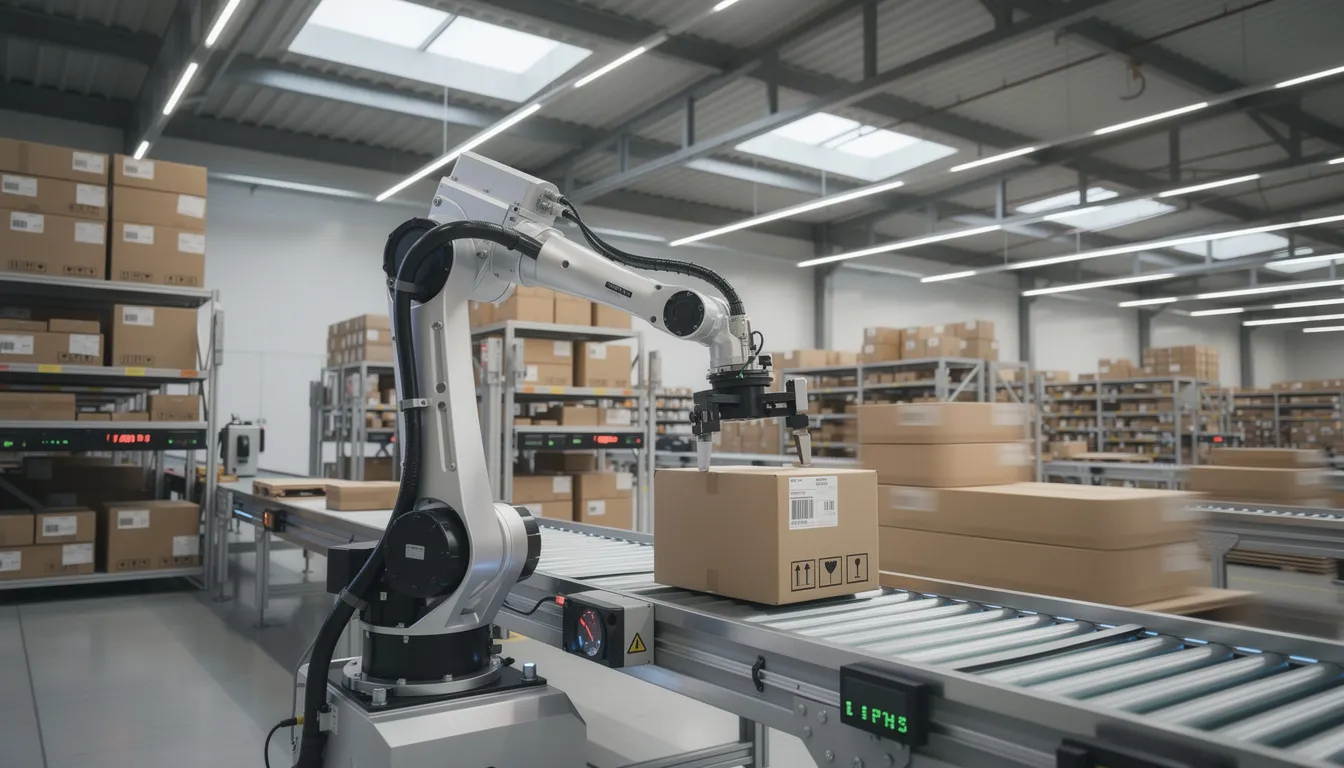
Logistics: UPS’s ORION system optimizes routes, saving 100 million miles annually (10 million gallons of fuel). Amazon operates 750,000 warehouse robots picking 75% of orders. Real world applications of AI technologies in supply chains deliver measurable P&L impact.
Consumer Tech: Voice assistants like Siri and Gemini process 1 billion queries daily. YouTube’s recommendation system drives 70% of views. iPhone computational photography enhances 2 billion photos monthly using diffusion models. These touch almost everyone.
Generative AI Tools (Post-2022):
Tool | Users/Impact | What It Does |
|---|---|---|
GitHub Copilot | 1.3 million users, 55% velocity boost | AI-assisted coding in IDEs |
Jasper.ai | 10 billion marketing words yearly | Content generation for businesses |
Midjourney | 15 million Discord users | Image generation for design teams |
Microsoft Copilot | 70% of Fortune 500 | Productivity assistant in Office 365 |
Adobe Firefly | Trained on 100 million licensed images | Ethical generative AI applications for creatives |
Robotics and Autonomy: Waymo logged over 20 million autonomous miles by 2025 with safety rates 85% better than human drivers per NHTSA data. Boston Dynamics’ Stretch handles 800 boxes per hour. Agility Robotics’ Digit entered 2025 pilot programs for GXO logistics. Autonomous vehicles and automated systems are real, operational, and expanding.
McKinsey projects $1 trillion in AI-generated value by 2030. Outages still matter-a 2024 Copilot downtime cost millions-but the systems themselves are undeniably production-grade.
The Limits of Real AI: Accuracy, Truth, and Bias
Accuracy vs. Truth
Being accurate on historical data isn’t the same as telling the truth. AI systems optimize for patterns, not philosophy. Understanding this gap is essential for anyone deploying or relying on these technologies.
Consider Amazon’s 2018 recruiting tool, trained on resumes from the previous decade. It learned to prefer male candidates because the training data reflected historical hiring patterns-60% male preference emerged from biased data, not malice. The tool was scrapped after a 20% error revelation. It was accurate in replicating the past while being fundamentally unfair.
ProPublica’s 2016 analysis of COMPAS recidivism scores found 45% racial disparity despite 65% overall accuracy. The system correctly predicted some outcomes while systematically disadvantaging Black defendants. Accuracy metrics like mean squared error or F1 scores measure prediction fit, not justice.
Understanding AI Hallucinations
The hallucination problem in generative AI:
Generative models produce plausible but fabricated content with alarming frequency:
Lawyers fined $5,000 for citing 33 non-existent cases from ChatGPT (2023)
New York Times sued OpenAI over 100 million article derivatives
Medical summaries with invented drug interactions
Academic papers with completely fabricated citations
These aren’t bugs that will be fixed next quarter. They emerge from how the systems work-generating probable sequences without grounding in external truth.
Fairness and Oversight
What’s required for AI to approximate truth and fairness:
Diverse teams auditing outputs before deployment
Human oversight loops for high-stakes decisions
Fairness constraints (which may reduce raw accuracy by 5-10% but align outputs ethically)
Transparent evaluation against human values, not just historical data
Data collection practices that account for incomplete data and historical biases
The knowledge gained from decades of computer science and problem solving in AI tells us that ongoing human oversight isn’t optional-it’s necessary. Real AI requires real responsibility.
How to Tell If an “AI Product” Is Worth Your Time (or Just Noise)
In a market flooded with 10,000+ new AI tools monthly (per Product Hunt), individuals and teams need filters. Most announcements are noise. Finding signal requires asking better questions.

Criteria for evaluating any AI tool in 2026:
Does it solve a painful problem?
Good answer: Quantifiable time savings >30%, measurable impact
Red flag: Vague promises of “efficiency”
Are limitations clearly stated?
Good answer: Published error rates, defined scope
Red flag: Claims of 100% accuracy
How is it updated?
Good answer: Model family disclosed (e.g., Llama 3.1 405B), quarterly retraining on proprietary data
Red flag: “Our AI” with no architecture details
Can you audit outputs?
Good answer: Provenance tracking via tools like LangChain
Red flag: Black box with no explanation
What happens when it’s wrong?
Good answer: Fallback protocols, human review triggers
Red flag: No error handling mentioned
Many “AI assistants” add friction or duplicate capabilities you already have in Excel, Notion, or basic search. Real value emerges when AI saves substantial time, improves decisions, or enables something previously impossible-like AlphaFold’s protein structure predictions or AI agents orchestrating multi-step workflows.
Questions to ask vendors:
What AI model family powers this? (Transformer, gradient boosting, something else?)
How often does it retrain on new data?
What data does it see, and can I control that?
Can I trace why it produced a specific output?
What’s the failure mode, and how do I recover?
If the answers are vague or evasive, you’re probably looking at AI-washing, not true AI.
Staying informed without drowning:
This is why KeepSanity AI exists. Instead of 50 daily newsletters padding content to impress sponsors, KeepSanity delivers one weekly email with only the major AI developments that actually happened-new models like Gemini 2.5, regulations like EU AI Act Phase 2, notable deployments at large firms. Teams at Bards.ai, Surfer, and Adobe subscribe because they need signal, not noise.
One curated weekly email beats daily micro-updates that burn your focus and energy.
Why the Question “Is AI Real?” Still Matters
As AI blends into everyday tools-from virtual assistants to fine tuning workflows-skepticism and clear thinking become more important, not less. The easier AI becomes to use, the easier it becomes to misunderstand.
Understanding what AI is-and isn’t-helps you:
Protect your job by knowing which capabilities are genuinely automated versus overhyped
Guard your data from systems that collect more than they should (2024 breaches exposed 1 billion records via insecure APIs)
Preserve your attention from an industrial revolution of content designed to capture eyeballs
Avoid wasting budget on fashionable but ineffective tech (Goldman Sachs warned of a $500 billion AI hype bubble in 2025)
Regulators worldwide are actively shaping AI rules. The EU AI Act enforces starting 2026. The US Executive Order mandates safety assessments. China regulates algorithms. Public understanding influences how strict or permissive these frameworks become-which affects everyone from large firms to individual developers.
Separating reality from science fiction also shapes how we think about longer-term ethical considerations. Discussions about AGI, superintelligence, and AI in warfare matter, but so do immediate issues: algorithmic bias, surveillance, misinformation, and broader societal impacts. The UK AI Safety Summit in 2023 spurred the creation of dedicated safety institutes precisely because experts take these risks seriously.
The industrial revolution transformed society over generations. AI development is moving faster. Staying informed through curated, low-noise sources-like a weekly briefing that covers only what matters-is one practical way to keep your sanity while the technology continues to evolve.
Lower your shoulders. The noise is gone. Here is your signal.
FAQ
Is today’s AI conscious or self-aware?
As of 2026, no evidence suggests any AI system-GPT-4, Gemini 2.5, Claude, or others-is conscious, self-aware, or sentient in the human sense. These systems recognize patterns and generate outputs based on statistical probabilities learned from training data. They don’t have inner experiences, feelings, or a stable sense of self awareness. Most AI researchers treat current models as powerful tools, not digital minds. Philosophers and futurists continue debating whether machine consciousness is theoretically possible, but nothing in deployed systems today demonstrates it. When you interact with an artificial agent, you’re engaging with sophisticated pattern recognition, not an unsolved problem of consciousness suddenly solved.
What’s the difference between AI, machine learning, and deep learning?
AI (artificial intelligence) is the broad goal of making machines perform tasks we associate with human intelligence-reasoning, perception, natural language understanding, planning. It’s the umbrella term from computer science going back to the 1950s.
Machine learning is a subset of AI that involves creating models by training algorithms to make predictions or decisions based on data.
Deep learning is a subset of machine learning that uses multilayered neural networks to simulate the complex decision-making power of the human brain.
Think of it as nested categories: all deep learning is machine learning, all machine learning is AI, but not all AI uses these approaches. Deep learning algorithms power most of today’s headline-grabbing systems.
Could AI ever become more intelligent than humans (AGI or superintelligence)?
AGI (artificial general intelligence) describes a hypothetical system that could match or exceed human performance across most cognitive tasks-not just narrow ones like playing chess, Go, or translation. Timelines are speculative. Some researchers predict AGI this century; others remain skeptical it will ever be achieved. There’s no consensus in 2026. What exists is serious work on AI safety and alignment. The UK AI Safety Summit in 2023 led to dedicated safety institutes. Major labs like Anthropic and DeepMind invest heavily in understanding how to build systems that remain beneficial as they become more capable. The question isn’t just “when” but “how do we ensure such systems serve human values?” That’s an unsolved problem receiving significant attention.
How can I personally use AI safely and productively?
Concrete everyday uses include: drafting and editing text (55% faster per GitHub Copilot studies), summarizing long documents (Notion AI users report 40% time savings), brainstorming ideas, basic coding help through tools like Cursor IDE, language learning with conversation practice, and simple data analysis. The key is verifying outputs. Always double-check factual claims from generative AI, especially in law, medicine, or finance. Keep sensitive personal or corporate data out of public models whenever possible. Set boundaries: use AI to speed up thinking, not replace it. Perform tasks that benefit from AI’s speed while applying your judgment to anything that matters. Cross-check important outputs with trusted sources or domain experts.
How can I stay up to date on what’s real in AI without getting overwhelmed?
Daily AI news creates fatigue and FOMO because much coverage involves minor product tweaks, sponsored content, or marketing announcements padded to fill airtime. The vast majority of daily updates don’t affect your work or decisions. Instead, rely on a small number of curated sources prioritizing impact over volume. Weekly briefings that focus only on major model releases, policy changes, and real-world deployments filter signal from noise. KeepSanity AI was built for exactly this purpose: one concise, ad-free weekly email covering only the major AI news that actually happened-curated from the finest sources, with smart links to papers and scannable categories. For teams that need to stay informed without sacrificing sanity, it’s the antidote to inbox overload.