Jobs That Will Be Replaced by AI (and What To Do Before 2030)
Between 2023 and 2030, artificial intelligence is set to reshape the job market in ways we’ve never seen before. Goldman Sachs projects that up to 300 million full-time equivalent jobs globally could be exposed to generative AI automation. The World Economic Forum estimates around 92 million existing roles will disappear by 2030-though they also forecast 170 million new opportunities will emerge. The bottom line: this isn’t a distant future problem. It’s happening now.
What Are 'Routine', 'Repetitive', and 'Data-Driven' Tasks?
Routine tasks are activities that follow a set, predictable process or established procedures, often requiring little variation or creative problem-solving.
Repetitive tasks involve performing the same actions or steps over and over, such as entering data, processing transactions, or responding to standard customer queries.
Data-driven tasks are those that primarily involve handling, processing, or analyzing structured information, often according to clear rules or guidelines.
These types of tasks are most exposed to AI automation. Roles in administration, manufacturing, customer service, data entry, and sales often involve routine, repetitive, or data-driven work, making them especially vulnerable to being automated by AI systems.
Key Takeaways
Between 2023 and 2030, AI is set to heavily automate routine office, customer support, and operational jobs. The scale is staggering: Goldman Sachs (2023) estimates 300 million full-time jobs globally could be exposed to generative AI automation. The WEF projects 92 million roles will disappear, while 170 million new ones will be created-a net gain, but cold comfort if your role is in the first category.
Jobs facing the highest immediate risk include:
Data entry clerks
Telemarketers and outbound call agents
Junior bookkeepers and accounts payable clerks
Basic customer service representatives
Entry-level warehouse pickers
Receptionists and schedulers
Junior copywriters and content producers
The critical distinction: most jobs won’t be completely wiped out. Instead, they’ll be redesigned around AI. For most workers, a fraction of daily tasks will be automated (drafting emails, summarizing reports, basic data cleanup), which reshapes job descriptions and reduces hiring demand but doesn’t obliterate the role entirely.
At KeepSanity AI, we track these shifts weekly across AI research, products, and labor data so you don’t have to wade through daily noise to understand what’s actually happening to your career.
How We Know Which Jobs AI Is Replacing Today
The projections you see in headlines aren’t guesswork. They come from rigorous analysis of labor market data, job postings, and corporate announcements from credible organizations. The World Economic Forum’s 2025 Future of Jobs Report analyzed employment trends across multiple countries and industries. Goldman Sachs’ 2023 paper on AI exposure examined which tasks across hundreds of occupations could technically be performed by generative AI. Forrester Research provides regularly updated forecasts distinguishing between jobs “exposed” to AI and those actually being eliminated.
Researchers spot “AI replacement” signals through several methods:
Faster-than-market decline in job postings: When a specific role drops 15-20% while the overall market dips only 8%, that’s a red flag.
Explicit mention of AI tools in job ads: Postings that now require “experience with AI automation platforms” or list AI tools as replacements for previous manual processes.
Corporate announcements: Companies publicly stating they’re using AI to reduce headcount or restructure teams.
Hiring freezes in specific functions: When companies stop hiring for roles they previously filled regularly.
Specific examples are telling. The U.S. Bureau of Labor Statistics projects bank teller employment will decline 15% from 2023 to 2033 (51,400 jobs eliminated). Cashier roles are expected to drop 11% (353,100 jobs). Medical transcriptionist employment is projected to decline 4.7% over the same period. IT unemployment jumped from 3.9% to 5.7% in a single month in 2024, driven by companies investing in AI rather than new hires.
There are limitations to this data. “Ghost jobs” (postings that remain open but never result in hiring) can skew numbers. Macroeconomic cycles unrelated to AI cause job losses that get incorrectly attributed to automation. Industry-specific downturns sometimes have nothing to do with ai technology. That’s why trend comparison over several quarters matters-it separates the signal from the noise.
At KeepSanity AI, we continuously watch these indicators weekly rather than relying on a single big report every few years. Major shifts get surfaced immediately; minor fluctuations don’t clog your inbox.
White-Collar Office Jobs Already Being Eroded by AI
Routine knowledge work is seeing the sharpest AI impact right now, especially roles built on predictable, rules-based tasks. If your job involves processing information according to clear guidelines, you’re in the crosshairs of ai automation.
Data Entry and Bookkeeping
Data entry clerks: RPA (Robotic Process Automation) and OCR tools like UiPath and Microsoft Power Automate have been replacing manual data keying across banks and insurers since 2020. The AI accounting market is projected to reach $53 million in revenue by 2030, reflecting massive industry adoption.
Basic bookkeeping and accounts payable/receivable clerks: Cloud accounting platforms with AI transaction categorization and invoice matching are reducing demand for junior accounting staff. From 2023 onward, companies are automating the routine number-crunching that used to require entire teams.
Administrative Support
Administrative assistants and schedulers: Calendar AI like Google’s Duet AI and Microsoft 365 Copilot now handles email triage, meeting scheduling, and document drafting. Entry-level admin teams are shrinking as these ai tools take over repetitive coordination tasks.
Market Research and Analysis
Market research analysts and junior analysts: Generative AI automates first-pass data summaries, chart generation, and survey coding. Entry-level positions in agencies and consultancies face significant pressure as the grunt work gets automated.
Legal Support
Paralegals and legal assistants: AI contract review and e-discovery tools have cut the hours spent on document review in US and UK law firms between 2023 and 2025. What once took teams of paralegals weeks now takes ai systems hours.
Senior professionals remain more resilient. Controllers, partners, and strategy leads blend judgment, client interaction, and accountability that current AI cannot shoulder. The pattern is clear: the more your role depends on following established procedures with minimal deviation, the higher your risk.

Customer-Facing Roles on the Front Line of AI Automation
AI is now sophisticated enough to handle millions of simple customer interactions per day. Volume-heavy, low-empathy roles are the most exposed-if your job involves reading from scripts and handling predictable questions, machine learning systems can likely do it cheaper and faster.
Telemarketing
Telemarketers and outbound call agents: AI voicebots and automated dialers are already replacing human callers. During the 2024 US election cycle, AI-powered political robocalls became a major controversy precisely because the technology had become indistinguishable from humans on simple outbound calls.
Customer Service
Basic customer service representatives: Chatbots and voice assistants now resolve password resets, order tracking, and FAQs at airlines, banks, and e-commerce companies. The 5% projected employment decline for customer service reps from 2023 to 2033 reflects this shift. Complex and escalated cases still need humans-but those represent a fraction of total volume.
Reception
Front-desk receptionists: AI reception kiosks and humanoid robots have been handling check-in and routing in Japanese hotels since the late 2010s. Corporate lobbies and co-working spaces are following suit, using automated systems for visitor management.
Sales
Store cashiers: Self-checkout has been around for years, but computer vision checkout-like Amazon’s “Just Walk Out” stores launched in 2018-represents the next wave. Grocery and big-box retail are steadily reducing checkout staffing.
Simple inside sales roles: AI recommendation engines in SaaS and e-commerce now handle cross-sell, upsell, and renewal prompts that used to require junior sales representatives. Basic transactional sales jobs are being absorbed by automated systems.
Relationship-driven, high-ticket sales remain relatively protected. Enterprise SaaS sales, complex B2B negotiations, and deals requiring trust, political navigation, and multi-stakeholder buy-in still demand human connection. Sales jobs at that level aren’t going anywhere soon.
Physical and Operational Jobs Being Transformed by Robotics + AI
While many hands-on jobs are safer than office work, automation is rapidly eating into the most repetitive tasks in logistics, manufacturing, and agriculture. The past few years have seen dramatic acceleration in robotic deployment across these sectors.
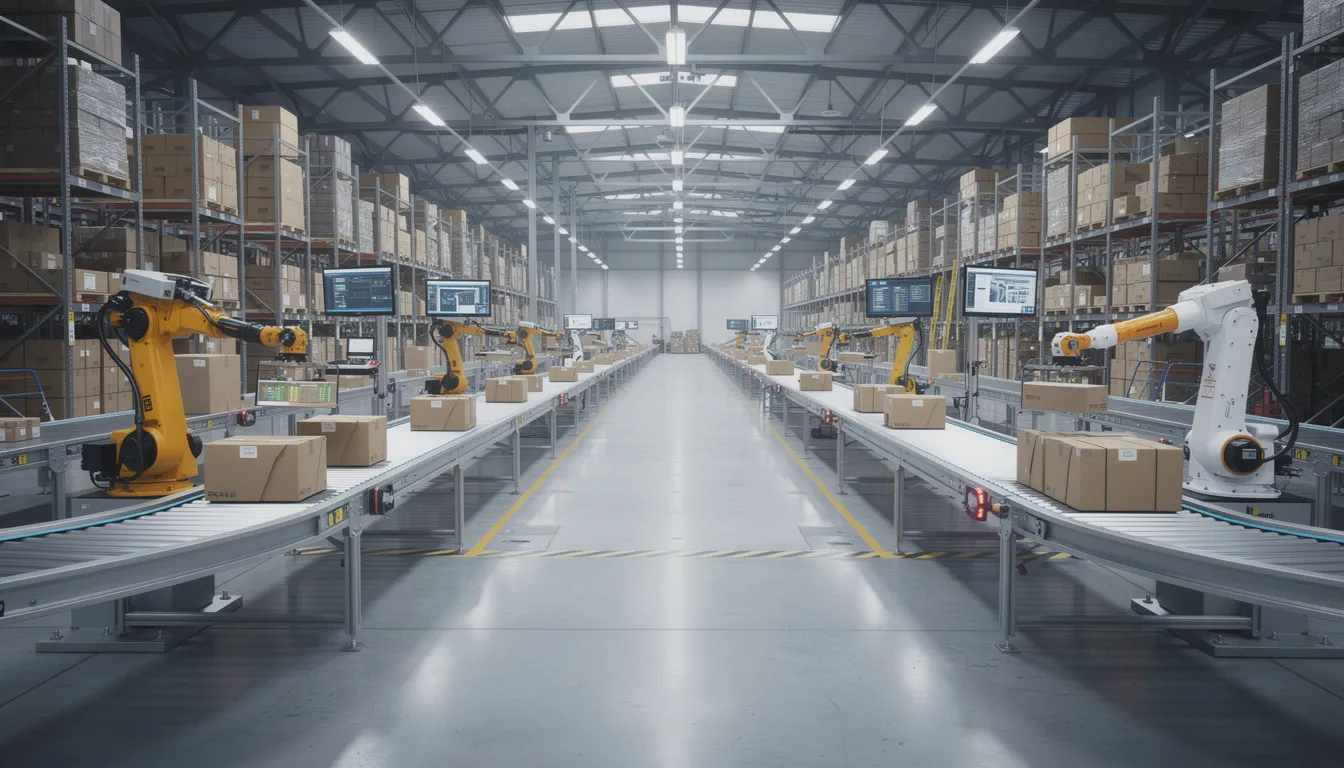
Warehouse pickers and packers: Amazon alone has deployed 750,000+ robots as of 2024 using systems like Kiva and Proteus for picking, sorting, and movement. Human roles are shifting toward oversight, exception handling, and managing the machines rather than performing the physical work.
Assembly line workers: Automotive and electronics factories have used computer-vision-guided robots for welding, painting, and inspection for decades. Since 2018, AI has accelerated this trend significantly. Research from MIT and Boston University indicates AI will replace as many as two million manufacturing workers by 2026.
Basic quality-control inspectors: AI vision systems now catch defects in semiconductor, food, and textile production with higher consistency than humans. The 6% projected decline in assembly positions from 2021 to 2031 reflects this technological advancement.
Agricultural laborers on large farms: AI-guided tractors, harvesters, and camera-based weeding robots are reducing demand for seasonal manual labor in US and European farms. By the late 2020s, large-scale farming operations will need far fewer workers for planting, weeding, and harvesting.
Simple courier and delivery roles: Autonomous delivery robots from companies like Nuro and Starship Technologies (already operating on college campuses) indicate long-term pressure on entry-level delivery jobs. Autonomous vehicles for last-mile delivery are being tested in multiple cities, though regulatory delays will slow full rollout.
Construction, emergency response, and complex repair work remain much harder to fully automate. Skilled trades like electricians, plumbers, and mechanics work in varied, unpredictable environments where full robotics replacement is uneconomic for most tasks through 2030.
Knowledge Jobs at High AI “Exposure” but Not Full Replacement
Some jobs show high AI exposure-meaning a large share of daily tasks can technically be automated-but are more likely to be reshaped than erased by 2030. The distinction between “exposed” and “eliminated” is critical here.
Research from 2025-2026 consistently shows that computer/math, business/finance, and education roles have significant percentages of tasks that generative AI can perform. But performing tasks isn’t the same as replacing humans who do them. Here’s where the nuance matters:
Teachers and trainers: Course prep, grading, and content creation can be automated. But classroom management, motivation, and the human touch in education keep humans central. You can’t automate inspiring a struggling student.
Writers and copywriters: AI drafts first versions, headlines, and SEO snippets, reducing demand for some junior roles. But the premium on investigative reporting, original analysis, and authentic voice is actually increasing as AI-generated content becomes commoditized.
Software engineers: Coding copilots like GitHub Copilot and Claude Code automate boilerplate and tests. Machine learning engineers and senior developers remain in high demand, but simple front-end and maintenance work may see slower hiring.
Data analysts and data scientists: Dashboards and natural-language query tools automate simple reporting. Analysts shift toward framing business questions, governing data quality, and advising stakeholders. The role evolves rather than disappears.
Corporate compliance and sustainability specialists: Documentation and monitoring tasks are automated, but interpretation of shifting regulations and board-level advising preserve senior positions. Complex decision making under regulatory uncertainty still requires human judgment.
The key takeaway: “exposed” does not equal “doomed.” These are precisely the roles where upskilling into AI collaboration pays off fastest. Learn to work with the ai tools, and you become more valuable, not less.
Jobs Least Likely to Be Replaced by AI
In some professions, AI is a tool rather than a substitute. The core value comes from empathy, hands-on skill, or complex leadership-qualities that current AI simply cannot replicate. These are the ai proof jobs for the foreseeable future.
Jobs at Risk of AI Replacement | Jobs Least Likely to Be Replaced by AI |
|---|---|
Data entry clerks | Healthcare providers (nurses, doctors, allied health) |
Telemarketers and call agents | Skilled trades (electricians, plumbers, carpenters, mechanics) |
Junior bookkeepers | Mental health professionals (psychologists, social workers) |
Basic customer service reps | Senior leaders (directors, VPs, CEOs) |
Entry-level warehouse pickers | Artists, designers, creators with strong personal brands |
Receptionists and schedulers | |
Junior copywriters |
Even these “safer” professions benefit from AI literacy. Doctors using AI for diagnostic support outperform those who ignore it. Tradespeople using AR/AI repair guides work faster and more accurately. The safest career path combines human advantages with technological capability.
How Many Jobs Could AI Replace by 2026 and 2030?
Concrete forecasts from credible organizations provide useful benchmarks, though they should be understood as ranges rather than certainties. The difference in estimates often comes down to whether studies measure “exposure” (AI can technically perform these tasks) versus “displacement” (these jobs will actually disappear).
Here are the key projections:
World Economic Forum (2025): Estimates approximately 92 million existing roles will disappear globally by 2030, while roughly 170 million new job opportunities will emerge-a net increase of about 78 million jobs worldwide.
Goldman Sachs (2023): Suggests up to 300 million full-time equivalent jobs worldwide could be exposed to generative AI automation, particularly in advanced economies. This is “exposure,” not guaranteed replacement.
Forrester Research (2026): Projects AI and automation could erase 10.4 million U.S. roles by 2030, equating to 6.1% of current U.S. jobs. This is notably more conservative than Goldman Sachs because it measures actual predicted displacement.
U.S. job market specifics: 30% of current U.S. jobs could be fully automated by 2030, while 60% will see significant task-level changes due to AI integration. This 30/60 split is important-it distinguishes between full automation and task modification.
The critical insight: “jobs exposed” does not mean “jobs eliminated.” For most roles, a fraction of daily tasks are automated (drafting emails, summarizing reports, basic data cleanup, invoice matching, meeting scheduling), which reshapes job descriptions and reduces hiring demand but doesn’t obliterate the role entirely.
We at KeepSanity AI track these large studies as they’re updated, surfacing only significant revisions in our weekly brief rather than repeating similar numbers every day. When the WEF releases a new report or Forrester updates their projections, you’ll know about it-without drowning in daily speculation.
How to Protect Your Career in an AI-Heavy Job Market
AI risk isn’t a death sentence for your career. It’s a signal to redirect toward skills and tasks AI struggles with. The workers who thrive in the next decade won’t be those who ignore AI or those who panic-they’ll be the ones who adapt strategically.
1. Map Your Current Tasks
Identify which daily activities are repetitive or rules-based. If you could write a detailed procedure manual for a task, AI can probably learn to do it. Those routine tasks are what gets automated first.
2. Double Down on Human Advantages
Communication, negotiation, storytelling, leadership, and domain expertise remain difficult for AI to replicate. Invest in skills development that emphasizes complex problems requiring judgment and interpersonal dynamics.
3. Learn AI Tools in Your Field
Microsoft 365 Copilot, ChatGPT, Adobe Firefly, GitHub Copilot, and industry-specific automation platforms are becoming baseline expectations. Data analysis with AI assistance is becoming table stakes across industries.
4. Pivot Within Your Domain
Move from execution-only roles to strategic or cross-functional positions. “Social media content scheduler” is vulnerable; “growth strategist” who uses AI to scale content is not. Same field, different risk level.
5. Build a Visible Portfolio
Real projects, case studies, and outcomes that demonstrate you can use AI to deliver more value-not be replaced by it. Companies want proof you can drive enhanced productivity through technological advancements.
6. Commit to Lifelong Learning
The ai revolution isn’t a one-time disruption. New skills will be required continuously. Build the habit now of staying current on major shifts without getting overwhelmed.
Consider subscribing to a low-noise, weekly AI briefing to track career paths being affected without drowning in daily headlines. Twenty minutes per week reading curated signal beats twenty hours chasing scattered noise.

How KeepSanity AI Helps You Track Which Jobs AI Is Replacing
We built KeepSanity AI for one reason: the AI news landscape is designed to waste your time. Most newsletters send daily emails packed with minor updates, sponsored content, and noise that burns your focus. They do this because advertisers pay for attention, not because there’s genuinely important news every day.
KeepSanity AI takes a different approach: one email per week with only the major AI news that actually happened. No daily filler to impress sponsors. Zero ads. Just signal.
Here’s how the newsletter specifically supports your career decisions:
We curate only major AI model releases, policy changes, and corporate adoption moves that actually move the job market needle. When companies like Salesforce or Amazon announce AI-driven workforce changes, you’ll know.
News is grouped into scannable categories (models, tools, business, robotics, resources, trending papers) so you can see in minutes where automation is accelerating across industries.
We link to research papers via services like alphaXiv and credible labor reports without forcing you to dig through paywalled or technical sources. Knowledge should be accessible.
We prioritize clarity over hype, calling out what AI can really do now versus what is still experimental. This helps you avoid overreacting to sensational job-replacement headlines that are more about clicks than reality.
If you’re feeling overwhelmed by AI job news-reading about new ai related jobs, worrying about job growth in your field, trying to understand what generative AI means for your future-a weekly signal-only update beats multiple noisy daily feeds. Lower your shoulders. The noise is gone. Here is your signal.
FAQ
Will AI completely replace my job, or just parts of it?
For the vast majority of roles, AI will automate specific tasks rather than replacing the entire job description. Major studies from the World Economic Forum and Goldman Sachs consistently model partial task automation, not 100% job elimination. Complete replacement is most likely where a role is almost entirely repetitive and rules-based-pure data entry, simple telemarketing scripts-and little human judgment is needed. Your action step: identify and shift toward the non-automatable parts of your role, including complex decisions, relationships, and creative problem-solving that solve complex problems humans still navigate best.
Which jobs are most likely to disappear by 2030 because of AI?
Several roles face highest risk of near-total automation by 2030: traditional telemarketers, basic data entry clerks, routine back-office processing clerks, simple warehouse pickers in highly automated facilities, and low-skill call-center agents who only handle FAQs. “Disappear” typically means hiring freezes and slow attrition rather than sudden mass layoffs everywhere. If you’re in these roles, explore adjacent positions in your industry that involve oversight of automated systems, exception handling, customer relationships, or process improvement. The work isn’t vanishing-it’s transforming.
What new jobs will AI create to replace the ones it automates?
Emerging roles include prompt engineers, AI product managers, AI safety and governance specialists, data annotators and evaluators, human-AI collaboration designers, and AI-augmented operations roles like GTM engineers and automation leads. Many new positions blend domain expertise with AI fluency-“AI-assisted radiologist” or “AI-enabled marketer” rather than pure technical AI jobs. Focus on learning how to supervise, audit, and creatively apply AI tools in your existing field. You don’t necessarily need to become a machine learning engineer; you need to become AI-capable in your own discipline. KeepSanity AI highlights these emerging roles when they begin appearing at scale in hiring data and company announcements.
How can I quickly check if my own job is at high risk from AI?
Check three signals: (1) how repetitive and rules-based your daily tasks are, (2) whether AI tools already perform similar work in your industry, and (3) whether job postings for your job title have been shrinking or changing requirements since 2023. Reputable job risk calculators and labor-market dashboards can provide directional guidance, but treat results as indicators rather than prophecy. Talk to managers and peers about which tasks are being automated first-and volunteer to own or shape those AI projects. Action matters more than having a perfectly precise risk score.
Is learning AI really necessary if I plan to stay in a “safe” profession?
Yes. AI literacy is becoming a baseline skill much like spreadsheets or email, even in roles that seem protected from automation. Doctors, teachers, hr managers, and leaders who know how to use AI tools will outperform peers who ignore them, even when their core work cannot be fully automated. Start with practical first steps: experiment with a major chatbot, try AI features in tools you already use (Office, Google Workspace, design software), and follow a single trustworthy weekly AI update. The goal isn’t becoming an AI engineer-it’s becoming AI-capable in your own discipline so you can create more value as the world of work evolves.