When Was Artificial Intelligence Invented? (A Clear Timeline From Idea to Reality)
If you’ve ever wondered when artificial intelligence was first invented, you’re asking a question that stretches across millennia of human imagination and decades of scientific work. The short answer: AI as a formal scientific discipline was born in 1956 at the Dartmouth Summer Research Project, where researchers including John McCarthy coined the term “artificial intelligence” and set the agenda for the field we know today.
But that single date only tells part of the story. The dream of creating thinking machines goes back to ancient myths and mechanical curiosities, while the technical foundations emerged in the mid-20th century through breakthroughs in computing machinery and early neural networks. Understanding this timeline matters now more than ever, as generative AI tools like ChatGPT, GPT-4, and Google’s Gemini reshape how we think about machine intelligence.
Key Takeaways
The formal “invention” of AI happened in 1956 at the Dartmouth Summer Research Project, where John McCarthy and colleagues coined the term “artificial intelligence” and established it as a named scientific discipline.
AI’s conceptual roots stretch back millennia, from ancient Greek myths of mechanical beings to medieval automata and Enlightenment dreams of mechanized reasoning-these shaped the intellectual pursuit that became AI.
Critical pre-1956 milestones made AI possible: Alan Turing’s 1950 paper “Computing Machinery and Intelligence” posed the question “Can machines think?” and introduced the Turing Test, while McCulloch and Pitts’ 1943 work on artificial neurons linked biology to computation.
Modern generative AI is part of a 70+ year evolution, not a sudden breakthrough-ChatGPT reaching 100 million users in two months in 2022 represents the latest chapter in a story that includes repeated booms and AI winter periods.
Understanding this history helps filter hype from reality: the original 1955–1956 AI agenda aimed for machines that use language, form abstractions, and improve themselves-goals that today’s large language models partially fulfill but don’t fully achieve.
What Do We Actually Mean by “When Was AI Invented”?
When someone asks “when was artificial intelligence invented,” they might be asking about different things: the first time humans imagined artificial beings, the first working computer systems that could learn or reason, or the moment AI became an organized scientific field with its own name and research agenda.
To clarify, historians generally recognize three levels of AI’s origin story:
Ancient and early-modern ideas of artificial beings, logic machines, and mechanized reasoning-conceptual precursors stretching back thousands of years
20th-century computing breakthroughs that made intelligent systems technically feasible, including early neural networks, digital computers, and foundational papers on computability
1950–1956 as the crystallization of AI into a named, funded discipline with shared terminology, organized research programs, and institutional backing
The key dates that anchor this timeline include:
Year | Milestone |
|---|---|
1943 | McCulloch and Pitts publish their model of artificial neural networks as logical computing units |
1950 | Alan Turing publishes “Computing Machinery and Intelligence,” introducing the Imitation Game |
1955 | McCarthy, Minsky, Rochester, and Shannon coin “artificial intelligence” in their Dartmouth proposal |
1956 | The Dartmouth workshop convenes, marking AI’s official birth as a field |
Most historians answer the question with: “AI was ‘invented’ as a field in the mid-1950s, especially at Dartmouth in 1956.” |
From a perspective focused on cutting through noise, understanding this distinction helps you interpret today’s AI boom more accurately. Modern generative AI isn’t a sudden miracle-it’s the latest chapter in a 70-year scientific story with cycles of progress, setback, and revival.
Early Ideas: Long Before Computers Looked Like Brains
The dream of artificial minds predates electronics by millennia. Long before anyone built a computer program, humans imagined mechanical servants, thinking automata, and devices that could reason. These ancient ideas shaped cultural expectations that later AI researchers inherited-and they’re worth knowing if you want to understand AI’s origins fully.
Ancient Myths and Mechanical Wonders
Greek mythology gave us some of the earliest examples of artificial beings. Talos, described in the Argonautica around the 3rd century BC, was a bronze automaton built by the god Hephaestus to guard the island of Crete. While purely mythological, Talos represented the human desire to create artificial life and intelligent systems that could act autonomously.
Real mechanical ingenuity followed. Around 250 BC, the Greek engineer Ctesibius built water clocks that used hydraulic feedback to regulate time-early control systems that prefigured self-regulating machines. In the Islamic Golden Age, the engineer al-Jazari (1136–1206) created programmable humanoid automata, including a mechanical figure that poured drinks using camshaft mechanisms to execute sequential operations.
These weren’t intelligent in any modern sense. They couldn’t learn, adapt, or understand human language. But they demonstrated that human beings had been trying to externalize and automate aspects of cognition for a very long time.
Mechanizing Reasoning
Beyond physical automata, some thinkers tried to mechanize reasoning itself.
Ramon Llull (13th century) developed his ars combinatoria-rotating paper wheels that generated logical combinations for philosophy and theology. It was crude, but it represented an attempt at algorithmic thinking centuries before digital computers.
Gottfried Wilhelm Leibniz (17th century) dreamed of a “universal characteristic” or calculus ratiocinator-a symbolic language that could reduce all thought to mechanical calculation. He imagined that disputes could be settled by saying “Let us calculate.”
Even literature captured this impulse. Jonathan Swift’s 1726 Gulliver’s Travels satirized the idea with the Grand Academy of Lagado’s “engine,” a machine that produced books via random letter arrangements. It was meant as mockery, but it presciently foreshadowed brute-force text generation-something that would become real centuries later.
These are not AI in the modern sense. There was no machine learning, no problem solving through data, no adaptation. But they show the deep roots of humanity’s effort to understand human intelligence by trying to replicate it mechanically.
From Mechanical Brains to Digital Computers (1900–1949)
Early Machines That Could “Think”
In 1914, the Spanish engineer Leonardo Torres y Quevedo built “El Ajedrecista” (The Chess Player), an electromechanical machine that could play chess endgames-specifically, king and rook versus king. Using electromagnets and simple logic circuits, it was the first industrial robot of sorts: an automated game-playing machine that could beat a human opponent in a limited domain. This wasn’t a general computer, but it proved machines could handle tasks requiring a form of intelligent behavior.
Theoretical Foundations: Turing and Computability
The theoretical foundations came in 1936, when Alan Turing published “On Computable Numbers.” This paper introduced the concept of the Turing machine-an abstract model of computation that proved any algorithmic process could be computed by a sufficiently powerful machine. Every digital computer since then rests on Turing’s insight.
World War II Accelerates Computing
World War II proved that computers could tackle complex, non-numeric problems at scale.
The Atanasoff-Berry Computer (1939–1942) was the first electronic digital computer, designed to solve linear equations.
ENIAC (1945), with its 18,000 vacuum tubes, could perform 5,000 additions per second and was used for ballistics calculations.
At Bletchley Park, Turing’s work on the Bombe machine cracked German Enigma codes through heuristic search-demonstrating that machines could handle pattern recognition and logical reasoning, not just arithmetic.
The First Model of Artificial Neurons
A crucial breakthrough came in 1943, when Warren McCulloch and Walter Pitts published a paper modeling neurons as threshold logic gates. Their work showed that networks of simple artificial neurons could, in principle, compute any logical function-linking biology, logic, and computation for the first time.
By the late 1940s, researchers started using terms like “electronic brain” and “thinking machine.” The Manchester Mark 1 ran Christopher Strachey’s 1951 checkers program-one of the first examples of AI software on real hardware. Norbert Wiener’s 1948 book Cybernetics formalized ideas about feedback and self-regulating systems.
The stage was set for AI to emerge as its own discipline.
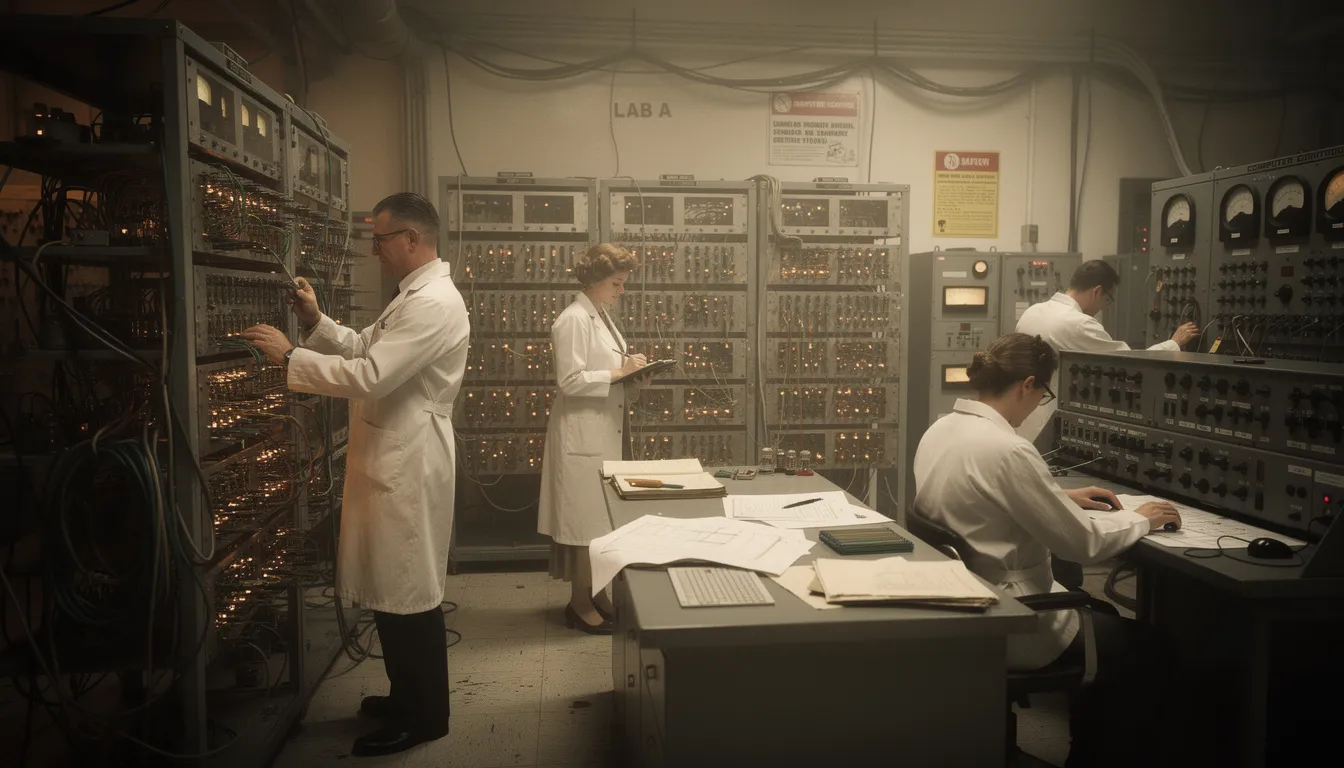
The Crucial Decade: 1950–1956 and the Birth of Artificial Intelligence
This is the core section that answers the question: when was artificial intelligence invented? Most scholars anchor the answer between Alan Turing’s 1950 paper and the 1956 Dartmouth workshop.
Turing’s 1950 Paper: “Can Machines Think?”
In 1950, Alan Turing published “Computing Machinery and Intelligence” in the journal Mind. This paper is foundational to the history of artificial intelligence for several reasons:
It posed the question “Can machines think?” and argued that digital computers could, in principle, simulate any form of intelligence given sufficient computing power and storage.
It introduced the Imitation Game, now called the Turing Test-a way to judge machine intelligence by whether a machine’s responses in conversation are indistinguishable from a human’s.
Turing predicted that by the year 2000, machines would be able to play chess at a high level and fool 30% of human judges in a five-minute conversation. The chess prediction came true early; the conversation benchmark took longer.
Turing’s paper gave AI research its intellectual charter. It framed machine intelligence as an empirical question that could be tested, not just a philosophical abstraction.
Early Proto-AI Systems (1951–1955)
Between Turing’s paper and the formal founding of AI, several early neural networks and learning programs appeared:
Year | System | Significance |
|---|---|---|
1951 | SNARC (Minsky & Edmonds) | First neural network machine; simulated 40 neurons learning a maze using reinforcement |
1952–1953 | Samuel’s Checkers Program (IBM) | Self-improving program that learned to play chess and checkers; coined “machine learning” in 1959 |
1955–1956 | Logic Theorist (Newell & Simon) | Proved mathematical theorems using heuristic search; often called the first AI program |
Arthur Samuel’s checkers program eventually beat its creator and drew with a Connecticut state champion by 1962, demonstrating that a computer program could improve through experience without explicit human intervention. |
The 1955 Proposal and the Term “Artificial Intelligence”
In 1955, John McCarthy, Marvin Minsky, Nathaniel Rochester, and Claude Shannon submitted a proposal for a summer research project at Dartmouth College. This document is where the term artificial intelligence first appeared in print.
The proposal was ambitious. It stated:
“We propose that a 2-month, 10-man study of artificial intelligence be carried out. The study is to proceed on the basis of the conjecture that every aspect of learning or any other feature of intelligence can in principle be so precisely described that a machine can be made to simulate it.”
They aimed to figure out how to make machines:
Use natural language
Form abstractions and concepts
Solve problems currently reserved for human beings
Improve themselves over time
The 1956 Dartmouth Workshop: AI’s Official Birth
The Dartmouth Summer Research Project took place in the summer of 1956, funded by the Rockefeller Foundation. About 10 researchers attended, including McCarthy, Minsky, Newell, Simon, and Shannon.
The workshop didn’t produce groundbreaking theorems or working systems. What it did was more important: it brought together the leading minds, established shared terminology, and set the research agenda for decades. AI research split into several tracks that persist today:
Symbolic search and logical reasoning
Pattern recognition and learning
Neural network models inspired by the human brain
Natural language processing
If you have to pick a single year, 1956 is generally considered the year artificial intelligence was “invented” as a field of study. The Dartmouth workshop marks the moment AI became an organized, named discipline rather than a scattered set of ideas pursued by individual computer scientists.
John McCarthy went on to create Lisp in 1958-a programming language that dominated AI research for decades and is still used today. The AI community had been born.
Early AI Milestones After “Invention” (1956–1970s)
Once AI was named, research moved quickly. Optimism ran high. Many researchers believed that machines capable of human like tasks-or even human intelligence-might be only 20 years away.
Symbolic AI and Expert Systems Take Shape
The late 1950s and 1960s saw rapid progress in symbolic AI:
Logic Theorist and General Problem Solver (1956–1957, Newell & Simon): These programs used means-ends analysis to solve puzzles like the Tower of Hanoi and prove logical theorems. They demonstrated that machines could perform logical reasoning.
Lisp (1958, McCarthy): This programming language enabled recursive symbolic manipulation and became the lingua franca of AI research.
ELIZA (1964–1966, Weizenbaum): This chatbot mimicked Rogerian psychotherapy using pattern-matching rules. It fooled some users into forming emotional bonds, despite having no understanding of human emotions or natural language meaning. It ran on just 2KB of memory.
STUDENT (1964, Bobrow): This program solved algebra word problems through semantic parsing.
Shakey the Robot (1966–1972, SRI): This humanoid robot integrated computer vision, planning, and navigation. It moved through cluttered rooms using A* search algorithms, representing one of the first autonomous systems.
Neural Networks Rise and Fall
Early neural networks showed promise. Frank Rosenblatt’s perceptron (1957) could learn to classify patterns that were linearly separable. By 1960, perceptron hardware was adjusting 400 weights automatically.
But in 1969, Marvin Minsky and Seymour Papert published Perceptrons, a book that proved single-layer perceptrons couldn’t solve certain simple problems (like XOR). This critique halted neural network funding for over a decade, even though backpropagation algorithms that could train deep neural networks were already known.
The First AI Winter
By the early 1970s, the gap between AI promises and AI reality became undeniable. Key problems included:
Combinatorial explosion: Search spaces in complex tasks exceeded 10^50 states, far beyond any computing power available.
Brittleness: Symbolic systems that worked in toy domains failed in the real world.
The Lighthill Report (1973, UK): This government-funded critique argued that AI research had failed to deliver on its promises, leading to massive cuts in government funding.
DARPA funding dropped from $3 million to under $1 million annually. This was the first AI winter-a period when interest, funding, and optimism for AI research collapsed. It wouldn’t be the last.
From Winters to Deep Learning and Generative Models (1980s–2020s)
The 1980s: Expert Systems and Neural Revival
The 1980s brought a new wave of AI enthusiasm, driven by expert systems:
MYCIN (1976, Stanford) diagnosed bacterial infections with 69% accuracy-comparable to human clinicians-using 450 rules and certainty factors.
XCON (Digital Equipment, 1980) configured VAX computers, saving $40 million per year.
Japan’s Fifth Generation project (1982–1992) aimed to build Prolog-based supercomputers for logic inference, backed by $850 million in government funding.
Neural networks also revived. In 1986, Rumelhart, Hinton, and Williams published their work on backpropagation, enabling training of multilayer networks. This teaching machines approach would eventually lead to deep learning techniques.
But the expert systems bubble burst. Knowledge acquisition proved painfully slow (10–100 rules per day, manually entered). The Lisp machine market crashed in 1987. A second AI winter followed (1987–1993), with funding dropping 90% in Japan and the US.
The 1990s: Behind-the-Scenes Progress
AI went quiet publicly but kept advancing in specific domains:
1997: IBM’s Deep Blue defeated world chess champion Garry Kasparov 3.5–2.5. The system evaluated 200 million positions per second using brute-force alpha-beta pruning and 8TB of endgame tables. It proved machines could play chess at superhuman levels-but it didn’t learn.
AI systems began powering search engines, recommendation systems, speech recognition, and financial trading-working behind the scenes without fanfare.
The Rise of Deep Learning
The deep learning revolution began with three ingredients: better algorithms, vastly more computing power, and big data.
Year | Milestone |
|---|---|
2006 | Hinton and colleagues re-popularize deep neural networks with pre-training techniques |
2009 | Researchers demonstrate that GPUs can accelerate neural network training 100x |
2009 | ImageNet dataset launched (14 million labeled images), enabling computer vision breakthroughs |
2012 | AlexNet wins ImageNet competition, halving error rates and triggering massive industry investment |
AlexNet, with its 8 layers and 60 million parameters, proved that deep learning models could learn complex patterns from raw data. This sparked an AI boom that continues today, with over $100 billion in industry investment flowing into AI technologies. |
The Transformer Era and Large Language Models
The current wave of generative AI traces directly to a 2017 paper: “Attention Is All You Need” by Vaswani et al. at Google. The transformer architecture introduced self-attention mechanisms that could process sequences in parallel and capture long-range dependencies in human language.
What followed:
GPT-1 (2018): OpenAI’s first generative pre-trained transformer
GPT-2 (2019): Larger scale, controversial release due to concerns about misuse
GPT-3 (2020): 175 billion parameters, trained on 570GB of text, demonstrating few-shot learning
ChatGPT (November 2022): GPT-3.5 fine-tuned with reinforcement learning from human feedback; reached 1 million users in 5 days and 100 million in two months-the fastest-growing app ever
GPT-4 (March 2023): Multimodal capabilities, scored in the top 10% on the bar exam
Gemini (December 2023): Google’s native multimodal model
Claude (2023–2024): Anthropic’s iteratively scaled competitor with multimodal features
These large language models can generate fluent text, answer questions, write code, and more. Virtual assistants powered by AI now handle everyday life tasks for hundreds of millions of users.

Challenges Remain
Despite the progress, current AI systems face real limitations:
Hallucinations: Studies show 20–50% factual error rates in certain benchmarks
Brittleness: Adversarial examples can fool 90% of models
Energy costs: GPT-3 training consumed approximately 1,287 MWh-equivalent to 120 US homes for a year
Bias and ethics: GPT-4 shows gender stereotypes in about 10% of outputs
Expert consensus (from figures like Yann LeCun and Yoshua Bengio) views this as a surge in narrow AI, not artificial general intelligence. The original 1956 goal of machines that truly understand human intelligence remains unfulfilled.
Why the “Invention” of AI Still Matters Today
Knowing that AI’s roots go back to the 1950s-and that the ideas themselves are even older-helps you interpret modern hype more calmly. This isn’t a technology that appeared overnight. It’s the product of seven decades of research, multiple boom-and-bust cycles, and countless incremental advances.
The Original Vision vs. Today’s Reality
The 1955 Dartmouth proposal aimed for machines that could:
Use human language
Form abstractions and concepts
Solve complex tasks
Improve themselves
Today’s large language models partially fulfill this vision. They can generate fluent natural language, handle knowledge representation tasks, and even demonstrate protein structure prediction capabilities. But they also fail at many forms of logical reasoning (scoring below 50% on certain benchmarks where average human performance is 85%), struggle with consistent factual accuracy, and require massive human intervention in their training.
Boom and Winter Cycles
The history of artificial intelligence includes repeated booms and winters:
Period | Phase | Cause |
|---|---|---|
1956–1973 | Early boom | Optimism about symbolic AI |
1974–1980 | First winter | Lighthill Report, funding cuts |
1980–1987 | Expert systems boom | Commercial applications |
1987–1993 | Second winter | Expert system limits, Lisp crash |
1993–2011 | Quiet progress | ML improvements, behind-the-scenes AI |
2012–present | Deep learning boom | GPUs, big data, transformers |
This pattern suggests that today’s AI surge might also encounter limits, regulatory pressure, or shifts in focus. Knowing the cycles helps you take a longer view.
Signal Over Noise
Understanding AI’s long timeline reinforces the value of careful, curated information over daily hype. Weekly tracking of major developments-like what KeepSanity AI provides-aligns better with how the field actually evolves: through gradual progress punctuated by occasional breakthroughs, not daily revolutions.
The “invention” of AI in 1956 didn’t create a finished technology. It kicked off an open-ended experiment in building and governing machine intelligence-an experiment that’s still running, with no clear endpoint in sight.

FAQ
So what year should I give if someone asks “When was AI invented?”
The most widely accepted answer is 1956, the year of the Dartmouth Summer Research Project on Artificial Intelligence. This is when AI was formally named and organized as a scientific discipline with its own research agenda, funding, and community.
For extra nuance, you could say: “The modern field of AI began in the mid-1950s, especially with John McCarthy’s 1955 proposal coining the term artificial intelligence and the 1956 Dartmouth workshop.”
Earlier work-like Alan Turing’s 1950 paper on computing machinery and intelligence, or McCulloch and Pitts’ 1943 neural network model-are crucial precursors, but they weren’t yet called “artificial intelligence.”
Who is considered the “father” of artificial intelligence?
John McCarthy is most often called the “father of AI” because he coined the term artificial intelligence in 1955 and organized the 1956 Dartmouth conference that established AI as a field.
However, AI’s parentage is shared. Other foundational figures include:
Alan Turing: Theoretical foundations, the Turing Test, and early vision of machine intelligence
Marvin Minsky: Neural network work (SNARC), symbolic AI, and long-term leadership of the AI community
Allen Newell and Herbert Simon: Created Logic Theorist and General Problem Solver, demonstrating practical AI systems
Claude Shannon: Information theory foundations critical to understanding computation
No single person invented everything. AI emerged from collaboration among many pioneering computer scientists.
What was the first true AI program?
Historians debate this, but the main candidates are:
Logic Theorist (1955–1956, Newell and Simon): Proved mathematical theorems using heuristic search. Often cited as the first AI program because it tackled general symbolic reasoning.
Arthur Samuel’s Checkers Program (early 1950s): Improved its play over time through machine learning, eventually beating its creator.
SNARC (1951, Minsky and Edmonds): An early neural network machine that learned maze navigation through reinforcement.
Logic Theorist often wins the title for “first full-fledged AI program” because it demonstrated symbolic reasoning and heuristic problem solving-capabilities central to the AI research agenda. But Samuel’s work pioneered machine learning, and SNARC pioneered neural approaches. All three represent important “firsts” in different aspects of AI.
How is “old AI” different from today’s generative AI like ChatGPT?
Classic “symbolic AI” (sometimes called GOFAI, or Good Old-Fashioned AI) relied on:
Hand-coded rules and expert systems
Explicit knowledge representation
Logical reasoning and symbolic manipulation
Systems like SHRDLU (1968), which could discuss a blocks world using natural language
Modern generative AI relies on:
Statistical pattern recognition from massive datasets
Deep neural networks with billions of parameters
Training on big data (hundreds of gigabytes of text)
Systems like ChatGPT that generate fluent output but need chain-of-thought prompting for complex reasoning
Despite these differences, both approaches attempt to realize the original 1950s goals: machines that can use human language, learn from experience, and solve complex tasks. They just take different paths to get there.
Why do people talk about “AI winters” in the history of artificial intelligence?
An AI winter is a period when interest, funding, and optimism for AI research sharply decline because the technology fails to meet inflated expectations.
There have been two main winters:
Mid-1970s to early 1980s: Triggered by the Lighthill Report (1973, UK), which criticized AI for overpromising. Government funding was cut dramatically.
Late 1980s to early 1990s: The expert systems bubble burst when these systems hit knowledge acquisition bottlenecks and couldn’t scale. The Lisp machine market collapsed.
Knowing about AI winters puts today’s hype cycles into perspective. The field has recovered from setbacks before, and it may face them again. This history underscores why careful, weekly curation of real breakthroughs-rather than daily noise-helps you fund AI research attention wisely and stay informed without burning out on hype that may not pan out.