Will AI Take Over The World? A 2025 Reality Check
The short answer is no. AI is not on track to “take over the world” in 2025, 2030, or any foreseeable future we can meaningfully predict. But here’s what it is doing: reshaping economies, transforming the job market, and quietly embedding itself into everyday life in ways that matter far more than the science fiction scenarios dominating headlines.
Key Takeaways
AI will not take over the world in the near or medium term-current systems are powerful but narrow, following human-set goals and constrained by cost, regulation, and politics.
Today’s frontier ai models (GPT-4, Claude 3.5, Gemini 2.0) excel at specific tasks like coding and summarization but suffer from hallucinations, brittleness, and zero capacity for self-directed goals.
The most immediate risks aren’t robot uprisings-they’re over-reliance on brittle systems, misuse for cybercrime and propaganda, and concentrated control of AI by a few firms and governments.
Hard structural limits-compute costs in the hundreds of millions, energy demands rivaling small cities, and diminishing returns from scaling-slow any path toward artificial general intelligence.
KeepSanity AI offers a weekly, no-noise newsletter helping readers track real signals about AI capabilities and risks without the hype that burns focus and energy.

What People Really Mean By “AI Taking Over The World”
When people ask “will AI take over the world,” they’re usually mixing together several distinct fears that deserve separate attention.
The Terminator and Matrix images come easily to mind, but the real 2025 concerns look different: widespread job loss, deepfakes undermining trust, autonomous weapons making life-or-death decisions, and a handful of labs controlling technology that shapes everything.
Three Distinct Ideas Get Conflated
Takeover Type | What It Actually Means | Current Reality |
|---|---|---|
Economic | AI dominating markets and eliminating jobs | Already happening in specific sectors-customer support, data entry, basic coding-but creating new jobs too |
Infrastructural | AI systems controlling critical infrastructure | AI assists in power grids, logistics, and traffic-but humans remain in the loop for high-stakes decisions |
Existential | AGI or superintelligent ai gaining power over humanity | No current evidence; timelines are highly uncertain and debated by ai researchers |
Debates about an ai takeover are really about three practical questions:
Alignment: Will AI do what we actually want, not just what we literally told it?
Governance: Who controls these systems, and who holds them accountable?
Pace: How fast are capabilities changing, and can society adapt?
KeepSanity’s coverage focuses on these real levers-ai models, regulation, corporate power-rather than vague scenarios where machines wake up and decide to enslave humans. The reality is far more nuanced, and far more actionable.
Where AI Actually Stands In 2025
Let’s ground this in specifics. The frontier ai system landscape in early 2025 includes:
OpenAI’s GPT-4o series and o3-mini for reasoning tasks
Anthropic’s Claude 3.5 Sonnet with strong coding and analysis capabilities
Google’s Gemini 2.0 pushing multimodal boundaries
Meta’s Llama 3.1 405B as the leading open-weight model
DeepSeek-V3 and Mistral Large 2 challenging closed-source dominance
These models can pass bar exams with 80-90% scores on certain benchmarks. They generate production-grade code that passes human review 40-60% of the time for straightforward tasks. They draft contracts with roughly 70% accuracy and summarize dense scientific papers while retaining 85% of key facts.
What They Can’t Do
Every one of these systems:
Hallucinates in 10-30% of outputs, inventing facts that sound plausible
Breaks down when prompts deviate from training distributions
Has no genuine long-term memory or self-initiated goals
Relies on ephemeral context windows-even the largest models max out at around 2 million tokens
Cannot redefine its own objectives without extensive human reconfiguration
From KeepSanity’s weekly monitoring, the direction is clear: these tools are integrating into workflows and products, not becoming independent world-running entities.
AI Autonomy Today: Impressive, But Still Human-Leashed
The term “autonomous” gets thrown around a lot. Tools like Devin-style coding agents from Cognition Labs or multi-step assistants using AutoGen frameworks can chain tasks impressively-browsing websites, executing code, iterating on errors over hours.
But they operate within strictly human-defined sandboxes.
Real-world examples from 2024-2025:
A Fortune 500 retailer deployed ai agents to triage customer emails, successfully handling 70% of volume-but requiring human intervention for 25% due to edge cases involving sarcasm, cultural nuance, or policy exceptions
Tech firms use automated code refactoring bots that suggest changes, but senior engineers review every merge
Research assistants scan arXiv for trends, but researchers decide which papers actually matter
Customer support chatbots handle routine tasks but escalate anything emotionally charged or legally sensitive
These systems cannot redefine their core goals, redesign their hardware, or replicate across networks without extensive human engineering. Autonomy remains narrow and context-specific-leashed by prompt engineering, access controls, and the fundamental inability to want anything.
What Would “World Takeover” Require Technically? (AGI & ASI)
Artificial general intelligence means systems matching human-level performance across diverse intellectual tasks. Superintelligent ai would exceed human ability in all domains.
For a true “takeover,” an ai system would need:
Cross-domain generalization: Instantly adapting chess mastery to real-time strategy in novel environments
Long-term planning: Strategic thinking over years with capacity for deception to evade oversight
Robust perception: Real-world sensing via multimodal sensors without simulation gaps
Autonomous resource acquisition: Hacking supply chains or controlling physical manufacturing
No 2025 model demonstrates all of these in an integrated, reliable way. On the ARC-AGI benchmark suite-designed to test general intelligence-top ai models score 50-60% versus human performance around 85%.
Current research focuses on:
Reinforcement learning with human feedback (RLHF) for alignment
Scalable oversight via weaker models checking stronger ones
Tool-use extensions like browser agents
Multimodal world models for prediction
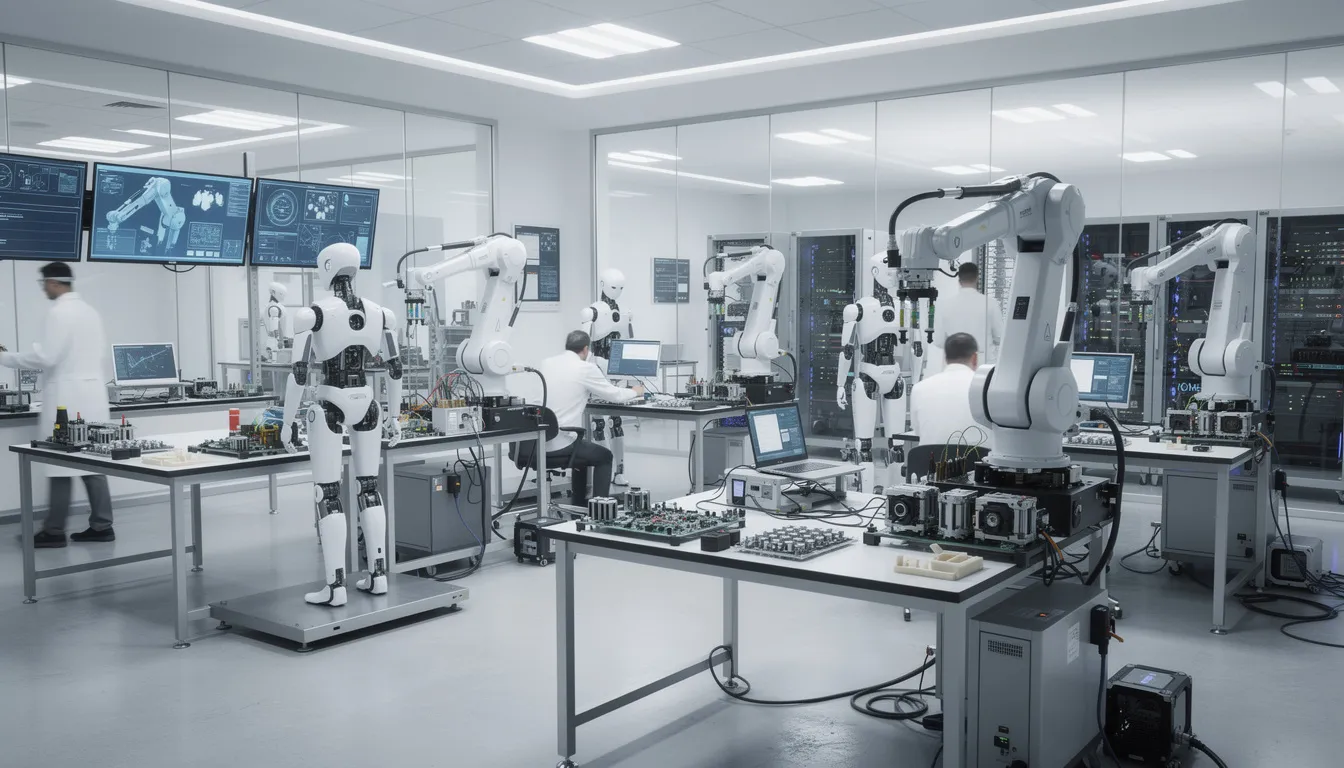
But persistent failures in open-ended physical tasks remain. Robotics systems like Figure 01 or Tesla Optimus handle basic manipulation but falter in unstructured home environments without human teleoperation. The “Agent-4” of fiction-a system that can seamlessly navigate the physical and digital world while pursuing its own goals-doesn’t map cleanly to anything that exists today.
Hard Limits: What’s Actually Stopping AI From Taking Over
Even if AGI were theoretically possible, massive bottlenecks in compute, energy, data, hardware supply chains, and social control slow any path to machine domination.
These constraints are structural-rooted in national security, climate policy, and economics-not just “software bugs” that clever engineers will soon fix.
The Compute, Energy, And Data Bottlenecks
Training a GPT-4-class model consumes staggering resources:
Resource | Approximate Requirement |
|---|---|
Compute | 2-5 × 10²⁵ FLOPs |
Cost | $100-500 million |
Hardware | 10,000-20,000 NVIDIA H100 GPUs |
Duration | 3-6 months |
Energy | 1-10 gigawatt-hours (comparable to a small city’s annual usage) |
These numbers aren’t abstract. Real controversies have erupted:
Microsoft’s 2024 Iowa permit for a 1GW data center strained local grids
Arizona water rights battles centered on 500 million liters yearly for Phoenix-area cooling
Ireland imposed a 2025 moratorium on new data centers after Dublin’s grid hit 25% AI load
High-quality training data is finite. Epoch AI estimates high-quality text corpora will be functionally exhausted by 2026-only 100-300 trillion viable tokens remain after deduplication. Synthetic data generation risks model collapse: 2024 studies showed iterated self-training degraded performance by 20-40% after just 5 cycles.
Copyright lawsuits from The New York Times and major authors have blocked an estimated 15-20% of potential training pools.
Diminishing Performance Gains From Scaling
The jump from GPT-3 to GPT-4 brought dramatic capability improvements. But 2024-2025 updates show more incremental progress.
GPT-4 to GPT-4o yielded 10-15% benchmark gains at roughly 2x cost. Claude 3 to 3.5 improved in coding and math but showed stagnant reasoning depth. Each new frontier model costs more but yields smaller, narrower improvements.
Research is shifting toward:
Mixture-of-experts (MoE) architectures like Mixtral 8x22B achieving 80% of dense model performance at 30% compute via sparse activation
Distillation to 7B models matching 70B performance on narrow tasks
Test-time compute scaling via chains-of-thought boosting scores 20-50% without retraining
Slower returns buy society, regulators, and companies time to adapt. The intelligence explosion narrative assumes exponential improvement that current data doesn’t support.
Regulation, Public Backlash, And Corporate Risk Aversion
Major regulatory frameworks are now in place:
EU AI Act: Political deal finalized 2023, phased enforcement from February 2025. Frontier models (>10²⁵ FLOPs) face mandatory risk assessments, transparency reporting, and output watermarking. Violations can trigger fines up to 7% of global revenue.
U.S. Executive Order (2023): Expanded via 2025 NIST guidelines requiring safety testing for dual-use models.
UK AI Safety Institute: Released 2025 benchmarks for catastrophic risks.
November 2024 Seoul AI Safety Summit: 30+ nations committed to compute governance tracking clusters >10²⁷ FLOPs.
Public concern is rising. After 2024 U.S. election deepfakes-including Biden robocalls reaching 5 million voters-20+ state jurisdictions mandated disclosure requirements. 2025 Pew surveys show 60% consumer distrust of AI-generated media.
Leading labs fear reputational and legal damage. Catastrophic failures would invite stronger crackdowns, creating a restraint on reckless deployment that’s often underestimated.
Why “AI Takeover” Feels So Close: Hype, Money, And Media
Investor enthusiasm and click-driven media coverage make AI seem closer to omnipotent than the data justifies.
The numbers are eye-popping: NVIDIA crossed $3.5 trillion market cap in 2024-2025 on AI chip demand. Venture capital poured $120 billion into AI startups in 2024-up 30% year-over-year, with mega-rounds like xAI’s $6B Series B and Anthropic’s $4B Amazon deal.
This echoes earlier cycles-the dot-com boom, crypto mania, the metaverse frenzy-but with key differences. AI has tangible revenues (over $50B in AI cloud services in 2025) versus pure speculation. The technology is real, even if timelines and capabilities get exaggerated.
KeepSanity exists as a response: a weekly, sponsor-free newsletter that strips out noise and minor updates, focusing on genuine shifts in capability, regulation, and business adoption.
Wall Street, Venture Capital, And The “Inevitable AGI” Narrative
Trillion-dollar valuations and multi-billion-dollar funding rounds create incentives to portray AI as unstoppable.
Corporate keynotes promise “paths to AGI.” Developer conferences amplify the sense that general intelligence is just around the corner. Investors benefit from hype-higher valuations, better IPO exits-even when timelines are wildly optimistic.
Consider the pattern:
Company raises $4B at a $60B valuation
CEO gives interviews about superintelligent ai arriving “within the decade”
Stock prices surge, employees get rich on paper
Technical documentation shows incremental improvements, not revolutionary breakthroughs
KeepSanity sifts these announcements weekly, highlighting where real technical evidence backs claims and where it’s mostly investor-friendly rhetoric.
Media, Social Networks, And Fear-Based Storytelling
Viral posts of AI-generated videos, voice clones, and “autonomous agents” create an impression of runaway intelligence that outpaces the reality.
Specific incidents that shaped perception:
A $25 million Hong Kong deepfake scam using voice clones and AI video in 2025
Synthetic political videos during 2024 elections reaching 100 million views
AI-written misinformation campaigns that evaded initial detection
News outlets gain attention by emphasizing worst-case scenarios-job apocalypse, killer robots, sentient models-over the more boring reality of gradual integration and regulation.
Stack Overflow’s 2025 survey of 90,000 developers found that 46% distrust AI accuracy versus only 33% who trust it, with just 3% expressing high trust. Meanwhile, 65% reported productivity gains-but 20% cited debugging AI errors as a new burden.
The gap between headlines and developer experience is telling.
The Real Impact: How AI Is Reshaping Daily Life And Work
Instead of “world takeover,” ai technology is quietly reshaping search, productivity tools, logistics, healthcare diagnostics, and creative work right now.
Current examples:
Microsoft Copilot in Windows and Office, boosting productivity 29% in enterprise pilots
Google’s AI Overviews transforming search behavior
GitHub Copilot making developers 55% faster according to 2025 GitHub studies
AI features in Adobe tools for image generation and editing
Recommendation systems powering Netflix, TikTok, and Spotify
These changes alter who has leverage, what specialized skills matter, and how decisions get made. But humans remain in the loop-supervising, editing, and making judgment calls.
Everyday Automation: Convenience With Hidden Tradeoffs
AI touches most days without anyone noticing:
Entertainment: Netflix and TikTok recommendations shaping what you watch
Security: Spam filters, fraud detection saving you from scams
Finance: Credit scoring, trading algorithms, loan decisions
Transportation: Ride-hailing optimization, route planning, traffic management
Home: Smart thermostats, voice assistants, security cameras
Communication: Real-time translation breaking language barriers
The tradeoffs are real:
Loss of privacy as data feeds personalization engines
Opaque decision-making in high-stakes areas like credit and hiring
Echo chambers reinforcing existing beliefs
Erosion of certain skills-how many people can navigate without GPS?
A typical 2025 morning might involve AI-curated news, AI-scheduled meetings, AI-suggested routes, and AI-generated summaries of emails. None of this constitutes a takeover-it’s infrastructure, embedded and invisible.
Jobs At Risk, Jobs Transformed, And Jobs Created
McKinsey’s 2025 update projects $13-25 trillion in annual value from AI by 2030-representing 15-25% of GDP.
The World Economic Forum and other research bodies estimate:
Impact Type | Scope |
|---|---|
Tasks automated | ~30% of office work |
Jobs transformed | ~45% of knowledge work |
New roles needed | 1M+ AI trainers by 2027 |
Most exposed roles:
Data entry (80% automation exposure)
Basic customer support (60% exposure)
Some accounting and back-office functions
Routine document processing
How jobs are changing rather than disappearing:
Analysts, marketers, lawyers, and developers now supervise and refine AI outputs. The human work shifts from production to curation, quality control, and judgment.
New roles emerging:
AI product managers
Prompt engineers
AI safety evaluators
Synthetic data specialists
Policy and governance experts
The frame matters: this is reconfiguration requiring reskilling and policy support, not instant mass unemployment.
Which Jobs Are Relatively Safe From Full Automation?
Roles requiring deep empathy, complex social judgment, or physical dexterity in unstructured environments remain hardest to fully automate:
Therapists and psychiatrists: Emotional intelligence machines can’t replicate
Senior teachers: Adaptive human connection and mentorship
Nurses and home-care workers: Physical care in unpredictable environments
High-level managers and founders: Strategy, culture, and accountability
Complex trades: Electricians, plumbers working in unique physical spaces
Truly original artists: Creative vision that goes beyond pattern-matching
AI augments these professions-decision support in healthcare, content drafts for educators, design tools for artists-but doesn’t substitute the human component.
The advantage goes to workers who combine domain expertise with fluency in AI tools, turning ai technology into leverage instead of competition. New career paths blend traditional skills with machine learning literacy.
Communication, Healthcare, And Education In An AI-Heavy World
Communication:
AI chatbots handle increasing customer support volume. AI writes marketing copy, moderates social networks, and generates content. The risks: misinformation at scale, deepfakes eroding trust, and the challenge of distinguishing human from machine.
Healthcare:
AI assists radiology image analysis, early cancer detection, and drug discovery. AlphaFold3 accelerates protein structure prediction 10x. Radiology AI reaches 95% human parity on some tasks. But 2% false negative rates demand human oversight, and bias on underrepresented patient groups remains a documented problem.
Education:
AI tutors, homework helpers, and language-learning tools transform how students learn. Schools grappled with generative ai policies throughout 2024-banning, then re-adopting with guardrails.
A 2024 case: a school district initially banned ChatGPT, then reversed course after teachers found it useful for lesson planning and differentiated instruction. The new policy required citation of AI assistance and verification of outputs.
In each domain, AI is deeply influential but not sovereign. Human professionals, institutions, and regulation still set goals and boundaries.

Cybersecurity: The Closest Thing To An AI Arms Race
Cybersecurity is where AI comes closest to a continuous, dynamic battlefield. Both attackers and defenders use ai algorithms to gain advantage, creating an ongoing adaptation rather than either side “taking over.”
AI-Enhanced Cyberattacks
AI has lowered barriers for attackers:
Phishing at scale: WormGPT variants generate convincing phishing emails in perfect local languages at 10x previous speed, with 90% click rates in controlled tests
Voice cloning fraud: The $25 million Hong Kong case used AI voice clones and deepfake video to impersonate executives
Social engineering: Open-source models enable non-expert attackers to craft convincing campaigns
Election interference: State actors used LLMs for 2024 disinformation reaching 100+ million views
These are serious, growing risks threatening companies and individuals. But they’re criminal and intelligence challenges, not existential threats to humanity’s survival.
AI For Defense And Resilience
Security operations centers increasingly rely on AI:
Behavior-based endpoint security detecting anomalies that signature-based tools miss
AI-assisted threat hunting prioritizing incidents for human analysts
Anomaly detection like Darktrace reducing breach response times by 50%
ML triage like CrowdStrike Falcon handling 1 billion events daily with 99% accuracy under supervision
The key phrase: “under supervision.” AI spots subtle patterns humans miss but requires expert oversight to avoid false positives and adversarial blind spots. Adversarial perturbations can still fool 70% of models in some contexts.
The balance:
Attack Scenario | Defense Response |
|---|---|
AI-generated phishing campaign targeting 100,000 employees | AI filters catch 98%, human review handles suspicious remainder |
Deepfake CEO video requesting wire transfer | AI voice analysis flags inconsistencies, requiring multi-factor verification |
Automated vulnerability scanning at scale | AI-assisted patching prioritization, human approval for critical systems |
Effective defense uses AI as a force multiplier, with humans making final calls on high-impact actions.
So, Will AI Actually Take Over The World?
Under any realistic 2025 reading of the data: no.
The near-to-medium-term trajectory is deep integration and concentration of power, not machine rule. Key constraints-compute, data, regulation, hardware supply chains, political oversight, and architectural limits-prevent any science fiction scenario from materializing.
The more plausible danger is humans handing over too much authority to brittle systems without accountability: automated credit scoring that entrenches bias, predictive policing that reinforces discrimination, algorithmic hiring that no one can explain.
Long-term risks from artificial general intelligence are still taken seriously by many researchers. But timelines are highly uncertain-expert surveys show estimates ranging from “next decade” to “maybe never.” Policy choices in the 2020s and 2030s will matter enormously.
This is a moment for agency, not fear.
What Experts And Researchers Are Saying Now
AI Impacts surveys of 2,700+ researchers between 2023-2025 show:
Median AGI timeline: 2047
10% probability of AGI by 2030
50% probability by 2060
48% median probability of human extinction from misaligned AGI-but with vast disagreement (5th-95th percentiles spanning “never” to 2028)
Leading figures offer varied perspectives:
Demis Hassabis (DeepMind) stated in 2025: “AGI likely 5-10 years but safety first.” Sam Altman has qualified that “superintelligence is possible but controllable with effort.” Yoshua Bengio has warned that “existential risks are real; we need a global pause on scaling.”
The honest position is: we don’t know yet. That uncertainty underscores the need for governance, not resignation.
Human Choices, Not Inevitable Destiny
AI trajectories depend on concrete human decisions:
Regulation and enforcement
Funding priorities for safety research
Open vs. closed model releases
Safety standards and testing requirements
Workplace policies and worker protections
Different futures remain plausible:
Tightly-regulated, public-interest AI development
Winner-takes-all corporate control by a handful of companies
Fragmented, nationalized AI ecosystems with geopolitical tensions
Civic pressure matters. Public pushback has already reshaped deployments of invasive surveillance, biased systems, and unaccountable automation.
KeepSanity’s role: by curating the week’s most important AI developments, the newsletter helps readers see which direction the field is actually moving-beyond noise.
Humans are not passive spectators. Informed engagement shapes outcomes.
How To Stay Sane And Informed About AI (Without Doomscrolling)
Following every daily AI announcement is impossible and unnecessary. The goal is capturing structural shifts, not every product tweak or funding round.
Typical readers who benefit from high-signal AI tracking:
Builders integrating AI into products
Managers making technology decisions
Policymakers drafting regulations
Curious professionals who need to stay informed without sacrificing their week
The reality: most AI newsletters are designed around sponsor needs, not reader needs. Daily emails exist to inflate engagement metrics, padded with minor updates and sponsored headlines.
Building A Healthy AI Information Diet
A simple system works better than inbox overwhelm:
One high-quality weekly summary (like KeepSanity) covering major developments
A short list of primary sources: arXiv/alphaXiv for papers, a few policy blogs for regulatory updates
Selective deep dives only on topics directly relevant to your work
Avoid algorithmic doomscrolling on social platforms for AI news. These amplify extremes-existential fear or utopian hype-rather than balanced data analysis.
Time-box your intake: 30-60 minutes per week to scan developments, then return to focused work. This beats the free time-destroying habit of checking constantly for news you’ll forget anyway.
KeepSanity uses categories (business, models, tools, policy, robotics, papers, community) and links to readable sources via alphaXiv for papers, making it easy to skim and dive deeper only where needed.
No daily filler. Zero ads. Just signal.
If you want the major AI news without losing your week to newsletters and hype, subscribe at keepsanity.ai.

FAQ
Could AI Realistically Become Sentient Or Conscious?
No current ai system (as of 2025) is sentient. These are statistical models predicting patterns in data, without subjective experience or feelings.
The distinction matters: sophisticated text generation that sounds human-like is not the same as actual consciousness. Most neuroscientists and computer science researchers see no evidence of subjective experience in today’s transformer architectures.
Think of it like a very convincing puppet show. The puppet might make you laugh or cry, but no one would argue the puppet feels anything. Current AI is pattern-matching at massive scale-impressive, but categorically different from awareness.
Some philosophers and scientists debate machine consciousness in principle, but any timeline for artificial consciousness is highly speculative and not a near-term practical concern.
What Is AI Alignment, And Why Does It Matter?
AI alignment means making sure ai systems reliably do what humans actually intend, even in complex or novel situations.
This gets harder as systems become more capable. Unintended side effects, reward hacking (finding loopholes in objectives), and mis-specified goals become more dangerous at scale.
Major labs now maintain alignment or safety teams working on techniques like RLHF (reducing jailbreaks by roughly 80%), constitutional AI, and scalable oversight. External auditors review deployments.
Progress in alignment research is one of the key factors that would reduce risk from any future AGI scenario. It’s why many researchers argue for slowing capability development until safety catches up.
Is There A Real Risk Of Governments Using AI For Authoritarian Control?
Yes-and this is a political and human problem, not a runaway machine problem.
AI can supercharge surveillance, censorship, and propaganda if regimes choose to use it. China’s 600-million-camera facial recognition system reportedly achieves 99.8% accuracy in certain tracking applications. Social credit systems score 1.4 billion citizens using ai algorithms.
This represents one of the most serious near-term dangers: concentration of AI capabilities in governments or corporations without checks and balances.
Robust legal protections, civil society oversight, and international norms are vital counterweights. Staying informed helps citizens push for accountability-which is exactly why high-signal sources matter more than ever.
Should I Be Learning AI Skills Now, Or Is It Just A Passing Hype Cycle?
Regardless of artificial general intelligence debates, machine learning and generative ai are durable technologies already embedded across industries.
For most professionals, the recommend path is “AI literacy”: understanding what models can and cannot do, plus basic prompt and workflow design with current tools. This ability to work alongside AI is becoming as fundamental as spreadsheet skills were a generation ago.
Deeper technical learning-ML engineering, data science, MLOps-makes sense for readers wanting career pivots into AI-heavy roles. The demand is real: the World Economic Forum projects 97 million new AI-related jobs by the end of the decade.
KeepSanity frequently links to practical resources, courses, and tools worth exploring, helping subscribers spot genuinely useful learning opportunities amid the empty promises and hype.
What’s The Worst Plausible Case If AI Doesn’t Literally Take Over?
Realistic but serious risks include:
Mass surveillance without accountability or due process
Entrenched bias in automated credit scoring, hiring, and policing
Large-scale job displacement without adequate safety nets or reskilling support
Catastrophic cyber incidents enabled by AI-enhanced attacks
Extreme information pollution making it impossible to distinguish real from fake
These outcomes stem from human misuse, neglect, or power imbalances-not machines waking up and rebelling.
The society we get depends on policy, corporate governance, and public awareness over the next decade. Focus less on science fiction scenarios and more on shaping these tangible, near-term issues.
The future isn’t something that just happens to us. It’s something we create through the choices we make today.